
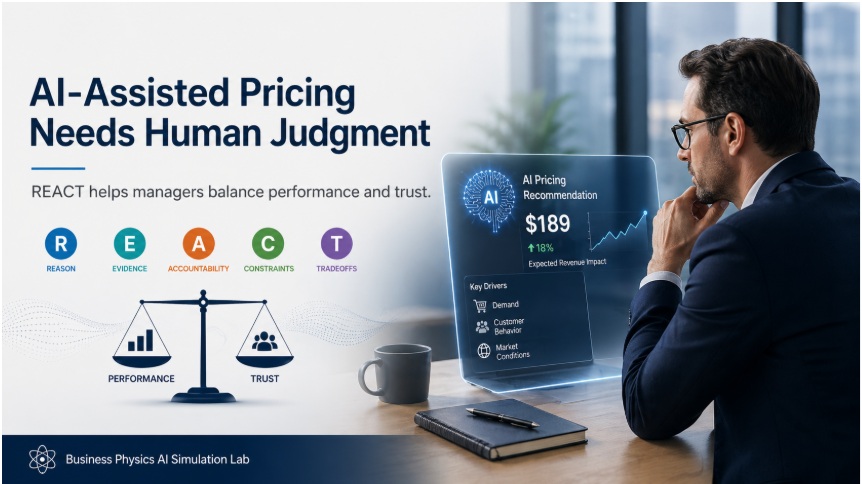
Algorithmic Pricing Is Not Just a Pricing Problem, it Is a Management Judgment Problem
How REACT can help managers make better decisions when AI-assisted tools influence price, trust, and customer value
An opinion piece from the Team at the Business Physics AI Simulation Lab
AI-assisted pricing requires better managerial judgment
AI-assisted tools are changing how managers make business decisions.
Pricing is one of the clearest examples.
In the past, managers often changed prices based on visible business factors: supply, demand, seasonality, inventory, competitor behaviour, cost changes, or limited capacity. A hotel raised prices during a major event. An airline increased fares as seats filled up. A rideshare platform introduced surge pricing when there were more riders than drivers.
Customers might not have loved those prices, but they could usually understand the basic logic.
| Traditional pricing factor | Why customers could understand it |
| Scarcity | There were fewer rooms, seats, tickets, or drivers available. |
| Demand | More people wanted the same limited supply. |
| Limited capacity | The company could not instantly create more hotel rooms, plane seats, or concert tickets. |
| Time pressure | Once the night, flight, or event passed, unsold capacity lost its value. |
| Seasonality | Customers understood that prices often rise during holidays, festivals, or peak travel periods. |
The pricing story made sense because the main variables were visible.
Algorithmic pricing changes that relationship.
Today, pricing systems can recommend or automatically adjust prices using large amounts of data. These systems may consider inventory, competitor prices, local demand, customer behaviour, browsing history, location, timing, device type, search patterns, loyalty status, and predicted willingness to pay.
That creates a new management challenge.
The question is no longer only: “Can this pricing system increase revenue?”
The better question is: “Can managers make better, fairer, more explainable, and more accountable decisions when AI-assisted tools influence the prices customers see?”
That is where the REACT framework becomes valuable.
REACT — Reason, Evidence, Accountability, Constraints, and Tradeoffs — gives managers a practical decision-support framework. It helps managers evaluate AI-assisted decisions before those decisions affect customers.
In the case of algorithmic pricing, REACT helps managers ask whether a pricing decision has a clear reason, whether the evidence is appropriate, who is accountable, what constraints apply, and what tradeoffs the firm is accepting between revenue, fairness, trust, and long-term customer value.
| REACT element | How it supports AI-assisted pricing decisions |
| Reason | Why is the price being changed? Is the purpose legitimate, explainable, and connected to customer or market value? |
| Evidence | What data supports the price change? Is the data relevant, fair, proportionate, and appropriate to use? |
| Accountability | Who owns the decision if the customer is harmed, misled, excluded, or treated unfairly? |
| Constraints | What legal, ethical, privacy, brand, and customer-protection boundaries must be respected? |
| Tradeoffs | What does the firm gain, and what might it lose in trust, loyalty, fairness, or long-term relationship quality? |
This matters because algorithmic pricing is not just a technical system. It is a customer-facing decision system.
The customer may not see the algorithm, but the customer experiences the result.
A price can feel fair, explainable, and connected to value. Or it can feel opaque, manipulative, and exploitative.
That is why algorithmic pricing should be understood as both a pricing issue and a trust-management issue. It is also a managerial judgment issue, because AI-assisted tools do not remove responsibility from managers. They increase the need for visible, structured, and accountable decision-making.
From the perspective of the Business Physics AI Simulation Lab, REACT helps managers preserve equilibrium between firm performance and customer trust.
The goal is not to reject algorithmic pricing.
The goal is to use AI-assisted pricing in ways that help the firm remain profitable while customers still feel respected, informed, and fairly treated.
Algorithmic pricing changes the management problem
Dynamic pricing is not new. Airlines, hotels, event venues, energy providers, logistics companies, and advertising platforms have used variable pricing for years.
What is changing is the speed, scale, personalization, and opacity of the decision.
AI-assisted pricing systems can operate faster than human managers. They can test more price combinations. They can use more variables. They can update prices in real time. They can personalize offers in ways customers may not understand.
That means the management challenge is no longer simply “setting the right price.” It is managing a decision system.
| Traditional pricing management | AI-assisted pricing management |
| Managers set pricing rules manually. | Managers design or approve systems that recommend or adjust prices. |
| Price changes are slower and more visible. | Price changes can be rapid, continuous, and difficult to explain. |
| Data inputs are usually limited and known. | Data inputs may be large, complex, behavioural, and opaque. |
| Responsibility is easier to identify. | Responsibility can become diffused across managers, vendors, data teams, and algorithms. |
| Customer fairness is easier to discuss case by case. | Customer fairness must be monitored across automated patterns. |
This is why managers need a decision-support framework.
Without one, firms risk treating AI-assisted pricing as a technical optimization problem when it is really a management judgment problem.
A pricing algorithm may be mathematically effective and still be commercially dangerous.
| What the algorithm may improve | What the firm may damage |
| Revenue | Trust |
| Conversion | Loyalty |
| Margins | Perceived fairness |
| Speed | Accountability |
| Automation | Explainability |
That is not a small issue. It goes to the heart of customer-centric management.
Price is not just a number. Price is a message.
In digital marketing, price is part of the customer experience.
A customer does not experience a price as a spreadsheet formula. He experiences it as a signal from the company.
| Type of price experience | Message received by the customer |
| A fair and explainable price | “We are exchanging value.” |
| A changing but understandable price | “The market conditions changed.” |
| A clear discount | “The company is giving me an opportunity.” |
| An unclear price | “I may not be seeing the full picture.” |
| A hidden-fee price | “The company waited too long to tell me the truth.” |
| A personalized but unexplained price | “The company may be using data against me.” |
| A manipulative price | “The company is trying to extract as much as possible.” |
This is why pricing is so closely connected to trust.
Customers can accept higher prices when the reason feels understandable. They may accept hotel prices rising during Grand Prix weekend. They may accept that flights cost more as seats disappear. They may accept that last-minute availability has a cost.
But customers react differently when the price appears to be based on something personal, hidden, or exploitative.
| Pricing explanation | Customer interpretation |
| “The room costs more because this weekend is almost sold out.” | The price is connected to visible scarcity. |
| “The room costs more because the system believes you are willing to pay more.” | The price feels like profiling. |
The first explanation is based on market conditions. The second is based on customer inference.
That difference matters.
A customer may dislike scarcity-based pricing, but he can understand it. He may feel very differently if he believes the company is using behavioural data, urgency, device type, income signals, or lack of alternatives to charge him more.
That is where pricing optimization can become trust erosion.
The danger is not dynamic pricing itself
A balanced management perspective should not treat dynamic pricing as automatically unethical.
Dynamic pricing can create real value.
| Dynamic pricing benefit | Customer or business value |
| Lower prices during low-demand periods | Customers with flexibility can save money. |
| Last-minute deals | Unsold inventory can become affordable. |
| Reduced waste | Products or capacity are less likely to go unused. |
| Better inventory clearing | Customers may access discounts. |
| Early-booking rewards | Customers benefit from planning ahead. |
| Better supply-demand matching | Services may remain more available. |
| Improved firm sustainability | The firm can continue investing, hiring, and serving customers. |
So the issue is not whether prices can change.
The issue is why they change, what evidence supports the change, who is accountable, what constraints apply, and what tradeoffs the firm accepts.
That is exactly why REACT is useful.
REACT does not say, “Do not use algorithmic pricing.” It says: “Make the managerial judgment visible before the algorithm reaches the customer.”
That is the heart of responsible AI-assisted decision-making.
Algorithmic pricing can create hidden asymmetry
Algorithmic pricing often creates an imbalance between the firm and the customer.
The firm has more data, faster systems, stronger predictive tools, and greater ability to test different prices. The customer usually sees only the final offer.
| What the firm can do | Why it matters for customer trust |
| The firm has more data. | The customer may not know what information is being used to influence the price. |
| The firm has faster systems. | Prices can change before customers have time to compare or understand them. |
| The firm can test thousands of price variations. | The firm can optimize revenue at a level of precision the customer cannot easily detect. |
| The firm can observe customer behaviour in real time. | Browsing, urgency, location, or repeat visits may become pricing signals. |
| The firm can change the offer before the customer understands the rules. | The customer experiences the outcome without fully understanding the pricing logic. |
| The firm can use AI to infer willingness to pay. | The customer may be priced according to what the system thinks he will tolerate. |
This creates what we can call pricing asymmetry.
The firm understands the system. The customer experiences the outcome.
That asymmetry does not automatically make algorithmic pricing unethical. But it does create responsibility.
The more powerful the pricing system becomes, the more important it is to govern it with judgment.
From a Business Physics perspective, asymmetry creates potential instability. If one side of the system accumulates too much advantage, the relationship becomes fragile.
The firm may think it is optimizing, but it may actually be increasing friction in the customer environment.
| Hidden friction created by algorithmic pricing | How it may appear later |
| Customers feel watched. | They become less willing to share data. |
| Customers suspect unfairness. | They compare prices more aggressively. |
| Customers feel tricked. | They leave negative reviews or complain publicly. |
| Customers lose confidence in the brand. | Loyalty declines. |
| Employees cannot explain pricing decisions. | Customer service quality weakens. |
| Regulators see repeated harm. | Legal and compliance pressure increases. |
The danger is that the algorithm may show “success” while the relationship is weakening.
That is why management cannot rely only on the pricing dashboard.
The dashboard may show revenue improvement, while the customer relationship is quietly deteriorating.
Customer-centric agility cannot mean faster extraction
This is where agility matters.
Agility is often misunderstood as speed. Move faster. Test faster. Automate faster. Optimize faster.
But customer-centric agility should mean something deeper. It means learning and adapting quickly in order to create better value for customers and the firm.
| Misunderstood agility | Customer-centric agility |
| Move faster. | Learn faster in order to serve better. |
| Test more price points. | Test whether value is being created fairly. |
| Automate more decisions. | Automate routine work while preserving human judgment. |
| Optimize revenue immediately. | Balance revenue with long-term trust. |
| React to demand quickly. | Respond to demand without exploiting the customer. |
| Personalize aggressively. | Personalize in ways that improve customer value. |
If a company uses algorithmic pricing to reduce waste, fill unused capacity, offer off-peak discounts, or make inventory available more efficiently, that can support customer-centric agility.
But if a company uses algorithmic pricing mainly to identify who can be charged more without noticing, that is not customer-centric. That is extraction.
The firm may be agile, but it is not customer-centric.
True agility should not be measured only by the firm’s ability to adjust prices quickly. It should also be measured by whether those adjustments preserve fairness, transparency, and trust.
A business can move quickly and still move in the wrong direction.
The broader management issue: AI now influences core business variables
Algorithmic pricing is only one example of a much larger shift.
AI-assisted systems increasingly influence the variables managers use to shape customer treatment.
| Business variable influenced by AI | Why managerial judgment matters |
| Price | Determines what customers pay and whether they perceive fairness. |
| Promotion | Determines who receives offers and who is excluded. |
| Segmentation | Determines how customers are grouped, targeted, and valued. |
| Personalization | Determines whether the firm helps customers or manipulates them. |
| Inventory allocation | Determines who gets access to limited supply. |
| Customer service prioritization | Determines who receives faster or better support. |
| Product recommendations | Determines what choices are made visible or invisible. |
| Risk scoring | Determines who may receive access, approval, or better terms. |
This means managers need to become more skilled at AI-assisted judgment.
The issue is not simply whether AI can produce a recommendation. The issue is whether managers can evaluate that recommendation responsibly.
AI may tell managers what is likely to work. REACT helps managers ask whether it should be done.
| AI-assisted system may answer | REACT helps managers ask |
| What price is likely to increase revenue? | Why is this price justified? |
| Which customer is likely to pay more? | Is it fair to use that information? |
| Which offer is likely to convert? | Does the offer respect customer interest? |
| Which segment is most profitable? | Are we excluding or disadvantaging customers unfairly? |
| Which action improves the dashboard? | What hidden costs might appear in trust, loyalty, or fairness? |
This is why REACT should be understood as a management decision-support framework.
It helps managers avoid confusing AI capability with business wisdom.
REACT as managerial decision support
REACT stands for Reason, Evidence, Accountability, Constraints, and Tradeoffs.
In the context of AI-assisted pricing, REACT helps managers decide whether a pricing algorithm should be approved, adjusted, paused, explained, audited, or rejected.
That distinction matters.
REACT is not only a reflection exercise after something goes wrong. It is a practical tool for making better decisions before the pricing system reaches the customer.
| Managerial decision moment | How REACT supports the decision |
| Should we use algorithmic pricing at all? | REACT clarifies the business reason and whether the pricing goal is legitimate. |
| What data should the pricing system use? | REACT helps managers distinguish market-based data from personal or vulnerability-based data. |
| Should this pricing rule be approved? | REACT forces managers to check evidence, customer impact, and fairness before launch. |
| Should the algorithm be allowed to operate automatically? | REACT identifies where human oversight, limits, or override rights are needed. |
| Should we explain the pricing logic to customers? | REACT helps determine what level of transparency is necessary to preserve trust. |
| Should the system be paused or changed? | REACT gives managers a basis for intervention when trust, fairness, or customer harm risks appear. |
| Should this be escalated to leadership, legal, or ethics review? | REACT helps determine when the decision exceeds normal pricing discretion. |
This is especially useful because algorithmic pricing decisions are rarely simple yes-or-no decisions.
Managers often face competing pressures.
| Pressure on the manager | REACT decision-support question |
| Increase revenue. | Are we creating value or extracting advantage? |
| Respond quickly to demand. | Are we moving fast without losing judgment? |
| Use available data. | Is this data relevant, fair, and proportionate? |
| Compete with other firms. | Are we following the market or contributing to harmful pricing patterns? |
| Automate decisions. | Where must human accountability remain visible? |
| Personalize offers. | Are we helping the customer or exploiting what we know about him? |
| Improve margins. | Are we measuring the trust cost of the margin gain? |
This is why REACT fits naturally with customer-centric agility.
It does not block adaptation. It improves the quality of adaptation.
A manager using REACT is not asking only: “Can the algorithm increase revenue?” He is also asking: “Should we use this algorithm in this way, with this data, under these constraints, for this type of customer, with these possible consequences?”
That is managerial judgment.
REACT helps managers move from technical approval to responsible business approval.
| Without REACT | With REACT |
| “The model improves revenue.” | “The model improves revenue, and we understand the customer impact.” |
| “The data improves prediction.” | “The data is relevant, fair, and appropriate to use.” |
| “The vendor says the system works.” | “Management remains accountable for how the system affects customers.” |
| “The algorithm adjusts prices automatically.” | “Automation operates within clear human-defined boundaries.” |
| “The dashboard shows better performance.” | “The dashboard includes both performance and trust indicators.” |
| “The system is legal.” | “The system is legal, explainable, proportionate, and aligned with customer trust.” |
This is the deeper contribution of REACT.
It turns algorithmic pricing from a black-box optimization process into a visible managerial decision.
Reason: Why are we changing the price?
The first REACT question is simple: Why are we changing the price? This question matters because not all reasons are equal.
| Stronger pricing reason | Why it is easier to defend |
| Demand is higher because capacity is limited. | The price reflects real scarcity. |
| Inventory is aging, so prices are lowered to clear stock. | The price change can benefit both firm and customer. |
| Off-peak discounts are offered to stimulate demand. | The customer receives a visible opportunity. |
| Prices adjust because costs have changed. | The firm can explain the economic pressure. |
| Early booking receives a lower price. | The customer is rewarded for planning ahead. |
| A loyalty discount is offered. | Customer data is being used to reward rather than punish. |
| Weaker pricing reason | Why it raises concern |
| The model predicts this customer will tolerate a higher price. | The price is based on estimated willingness to pay, not necessarily value. |
| The customer appears urgent. | The system may be exploiting need or anxiety. |
| The customer seems less likely to compare alternatives. | The system may be exploiting information asymmetry. |
| The customer has a history of accepting higher prices. | Loyalty may be punished instead of rewarded. |
| The customer is using a device associated with higher income. | The system may be using a proxy for wealth. |
The question is not only whether the company can charge more. The question is whether the reason for charging more is defensible from a customer-centric perspective. Business students and managers should learn that pricing power is not the same as pricing wisdom.
Evidence: What data justifies the price?
The second REACT question asks what evidence supports the price change. This question forces the firm to examine the data behind the decision.
| Market-based data | Why it may be easier to justify |
| Inventory levels | They show how much supply is available. |
| Time of purchase | They relate to scarcity and planning behaviour. |
| Seasonal demand | They reflect predictable market patterns. |
| Competitor prices | They help the firm remain market-aware. |
| Booking windows | They connect timing to capacity management. |
| Available capacity | They reflect the supply side of the market. |
| Personal or behavioural data | Why it creates higher trust risk |
| Browsing history | It may reveal interest, urgency, or repeated comparison. |
| Device type | It may be used as a proxy for income or willingness to pay. |
| Location | It may connect price to neighbourhood, wealth, or access. |
| Inferred income | It turns pricing into personal profiling. |
| Urgency signals | It may exploit need, stress, or lack of time. |
| Behavioural vulnerability | It may target the customer’s weaker position. |
The first group mostly explains the market situation. The second group may profile the person. Personal data can create value when used for discounts, loyalty offers, student pricing, or helpful personalization. But when personal data is used invisibly to raise prices, the trust risk becomes much higher.
Accountability: Who owns the outcome?
The third REACT question asks who is accountable for the pricing decision. This is critical because algorithmic systems can create responsibility gaps.
| Common responsibility gap | Why it is dangerous |
| “The model set the price.” | It treats the algorithm as if it were responsible. |
| “We only built the system.” | It separates technical design from customer impact. |
| “The vendor controls the tool.” | It shifts responsibility away from the firm using the system. |
| “The system was optimizing revenue.” | It ignores fairness, trust, and customer experience. |
| “No one manually selected that price.” | It confuses automation with innocence. |
| Accountability question | Customer-centric purpose |
| Who approved the pricing logic? | Ensures that the system was not launched without managerial judgment. |
| Who monitors customer impact? | Ensures that trust and fairness are observed after deployment. |
| Who reviews fairness concerns? | Ensures that bias or harm can be identified. |
| Who can override the algorithm? | Ensures that human judgment remains available. |
| Who handles complaints? | Ensures that customers have a path to challenge or question outcomes. |
| Who decides when the system must be changed or stopped? | Ensures that the firm can correct harmful patterns. |
Customers do not buy from an algorithm. They buy from a company. Without accountability, algorithmic pricing becomes a black box with no responsible human judgment behind it.
Constraints: What boundaries should the system respect?
The fourth REACT question asks what legal, ethical, and customer-protection constraints apply. This reminds managers that pricing does not happen in a vacuum.
| Constraint area | Pricing question for managers |
| Consumer protection | Are customers being misled? |
| Price transparency | Are fees hidden or revealed too late? |
| Advertising honesty | Is the advertised price actually attainable? |
| Privacy | Is personal data being used in a way customers would reasonably understand? |
| Fairness | Are similar customers being treated differently without a defensible reason? |
| Vulnerability | Are urgent, stressed, or dependent customers being targeted? |
| Product type | Are essential products being treated differently from luxury products? |
| Brand integrity | Would we be comfortable explaining this pricing logic publicly? |
If the company would be embarrassed to explain the pricing system to customers, journalists, regulators, or students, that is a warning sign. A pricing strategy that depends on invisibility is already creating trust risk.
Tradeoffs: What are we gaining, and what might we lose?
The fifth REACT question asks what tradeoffs the firm is accepting. This is where the conversation becomes strategic.
| Possible business gain | Possible trust cost |
| Higher revenue per customer | Customers may feel exploited. |
| Better margin optimization | Customers may feel the firm is unfair. |
| Faster response to demand | Customers may feel prices are unstable or unpredictable. |
| More precise segmentation | Customers may feel profiled. |
| Increased conversion value | Customers may lose confidence in the brand. |
| Better inventory management | Customers may accept it only if the logic is explainable. |
| What the dashboard may show | What the customer environment may reveal |
| Revenue per customer increased. | Customers feel less respected. |
| Conversion value improved. | Repeat purchase intention declines. |
| Margins improved. | Complaints increase. |
| Prices adjusted efficiently. | Customers perceive instability. |
| The algorithm performed well. | The relationship weakened. |
From a Business Physics perspective, this is a measurement problem. The firm is measuring visible gain while ignoring hidden friction. A better pricing system would measure both revenue performance and trust impact.
A simple classroom example: Montreal hotel pricing
Imagine a hotel in Montreal during a major event.
The hotel uses algorithmic pricing to increase rates as rooms become scarce. This is understandable. The reason is clear. The evidence is visible. The capacity is limited. Customers may not love the higher price, but they can understand it.
Now imagine a different system.
The hotel uses customer data to estimate who is booking urgently, who is browsing from a wealthier postal code, who uses a more expensive device, or who has searched multiple times and seems anxious to secure a room. The system then raises the price for that person.
This second example feels different.
| Scarcity-based pricing | Vulnerability-based pricing |
| The price rises because rooms are almost sold out. | The price rises because the customer appears urgent. |
| The explanation is connected to limited supply. | The explanation is connected to personal behaviour. |
| Customers may dislike it but understand it. | Customers may feel profiled or manipulated. |
| The firm is responding to market conditions. | The firm may be exploiting customer asymmetry. |
| The pricing logic is easier to defend publicly. | The pricing logic is harder to defend publicly. |
| Pricing type | Basic judgment |
| Scarcity-based pricing | May be defensible. |
| Demand-based pricing | May be defensible if transparent. |
| Cost-based pricing | May be defensible if explained honestly. |
| Loyalty discounting | May be defensible if it rewards the customer. |
| Vulnerability-based pricing | Much harder to defend. |
| Hidden personalized price increases | High trust risk. |
That distinction is exactly why REACT matters. It helps managers separate legitimate pricing adaptation from customer exploitation.
Business Physics view: equilibrium, not extraction
The Business Physics AI Simulation Lab views this as an equilibrium problem.
A firm needs revenue. That is not wrong. Firms need profit to survive, hire people, invest, innovate, and serve customers.
Customers also need fair value. They need to feel that they are not being misled, profiled unfairly, or punished because an algorithm has detected urgency or vulnerability.
The goal is not to choose the firm over the customer or the customer over the firm. The goal is value equilibrium.
| Healthy system condition | Why it matters |
| The firm earns a fair return. | The business remains financially sustainable. |
| The customer receives fair value. | The customer feels respected, not exploited. |
| The pricing logic is explainable enough to preserve trust. | The customer can understand the basis of the price. |
| The firm uses data responsibly. | Data supports service quality instead of manipulation. |
| Management remains accountable. | The company cannot hide behind the algorithm. |
| The relationship remains stable over time. | Long-term value is protected. |
This is not idealism. It is good business physics.
When the firm pushes too far toward extraction, it creates friction. When customers lose trust, the system becomes less stable. When regulators intervene, the firm loses freedom. When customers feel manipulated, brand value declines.
A pricing model that maximizes revenue today but weakens trust tomorrow is not truly optimized. It is simply shifting cost into the future.
A contribution from the Business Physics AI Simulation Lab
The contribution of the Business Physics AI Simulation Lab is to frame algorithmic pricing as a system-level trust and management judgment problem.
Traditional pricing discussions often focus on revenue, demand, elasticity, segmentation, and profit maximization. These are important. But they are incomplete.
A Business Physics perspective adds another layer.
| Business Physics question | System-level meaning |
| What forces are being created in the customer environment? | Pricing decisions influence behaviour, loyalty, and perception. |
| What friction is being introduced? | Hidden unfairness can make the relationship harder to sustain. |
| Is trust increasing or decreasing? | Trust affects the stability of the customer relationship. |
| Is the firm moving toward equilibrium or instability? | Short-term profit may create long-term system imbalance. |
| Is the algorithm improving the system or quietly damaging it? | Technical success does not always mean business health. |
| Is managerial judgment visible? | Responsible decisions should be explainable, reviewable, and accountable. |
This perspective matters because firms often optimize what they can easily measure.
Revenue is easy to measure. Trust is harder. But what is harder to measure may still be essential to system stability.
Trust functions like structural integrity. You may not notice it when everything is working. But when it weakens, the whole system becomes more fragile.
Algorithmic pricing therefore needs to be evaluated not only as a revenue engine, but as a force acting on the customer relationship.
And AI-influenced management decisions need to be evaluated not only by whether they improve performance, but by whether they preserve accountability, fairness, and equilibrium.
Toward a REACT-based pricing discipline
The practical recommendation is that firms should create a REACT-based review before deploying algorithmic pricing systems.
Before launching or updating a pricing algorithm, managers should document the reasoning behind the system.
| REACT element | Pricing question | Customer-centric purpose |
| Reason | Why are we changing prices dynamically? | To ensure the purpose is legitimate and value-based. |
| Evidence | What data supports the pricing decision? | To ensure the data is relevant, fair, and proportionate. |
| Accountability | Who owns the customer impact? | To prevent responsibility from disappearing into the algorithm. |
| Constraints | What legal, ethical, privacy, and fairness boundaries apply? | To protect customers and the firm from harmful practices. |
| Tradeoffs | What do we gain, and what trust risks do we accept? | To balance revenue optimization with long-term relationship health. |
This does not need to become bureaucratic. It can be lightweight. But it must be explicit.
The point is to make judgment visible before the algorithm reaches the customer.
That is the heart of responsible AI in pricing.
Broader management lesson
Algorithmic pricing is only one case.
The larger lesson is that AI is changing the nature of managerial decision-making.
Managers are increasingly making decisions with systems that can recommend, rank, price, segment, predict, and personalize. These systems can be useful. They can improve efficiency. They can reveal patterns humans might miss. They can help firms respond faster.
But they can also create distance between the manager and the consequence of the decision.
That is why decision support must not become decision surrender.
| AI can support management by… | Managers must still ensure that… |
| Detecting patterns | The pattern is meaningful and not misleading. |
| Recommending prices | The price is fair, explainable, and defensible. |
| Segmenting customers | The segmentation does not create unfair treatment. |
| Predicting willingness to pay | The prediction is not used to exploit vulnerability. |
| Automating adjustments | Human-defined boundaries remain in place. |
| Improving performance metrics | The metrics do not ignore trust, fairness, or harm. |
This is the managerial contribution of REACT.
It helps managers avoid confusing AI capability with business wisdom.
AI may answer: “What is likely to increase revenue?” REACT forces the manager to also ask: “Is this the right thing to do, with this data, for this customer, in this context, given these consequences?”
That question is not anti-business. It is better business.
The best pricing system is not the one that charges the most
Algorithmic pricing is becoming normal. That does not mean it should become invisible, unquestioned, or unaccountable.
The future of pricing is not only about better prediction. It is about better judgment.
The best pricing system is not the one that extracts the maximum possible amount from each customer. The best pricing system is the one that helps the firm remain profitable while customers still feel respected, informed, and fairly treated.
That is the equilibrium. That is the customer-centric standard. And that is where REACT becomes valuable.
| Before asking only this | Also ask this |
| How much can we charge? | Why are we charging this? |
| Can the algorithm increase revenue? | What evidence justifies the pricing decision? |
| Can we personalize the price? | Who is accountable for the customer impact? |
| Can we optimize faster? | What boundaries must we respect? |
| Can we improve margin? | What trust might we be losing? |
Those questions do not slow innovation. They protect it.
Because in the long run, firms do not only compete on price. They compete on trust.
And in an AI-shaped marketplace, trust may become one of the most important forms of competitive advantage.
From the perspective of the Business Physics AI Simulation Lab, this is the deeper point: AI should not push firms into faster extraction. AI should help managers create better equilibrium.
| Responsible AI-assisted pricing should ensure that… | Why it matters |
| The firm wins. | The business remains sustainable. |
| The customer wins. | The relationship remains fair and valuable. |
| The decision is explainable. | Trust can be maintained. |
| Accountability remains human. | The firm cannot hide behind the system. |
| The system becomes healthier, not more fragile. | Long-term value is protected. |
That is responsible algorithmic pricing and that is what managerial judgment must become in the age of AI.
 English
  Arabic
  Chinese
  French
  Hindi
Hindi  Portuguese
  Spanish