
Category: AI Article
-
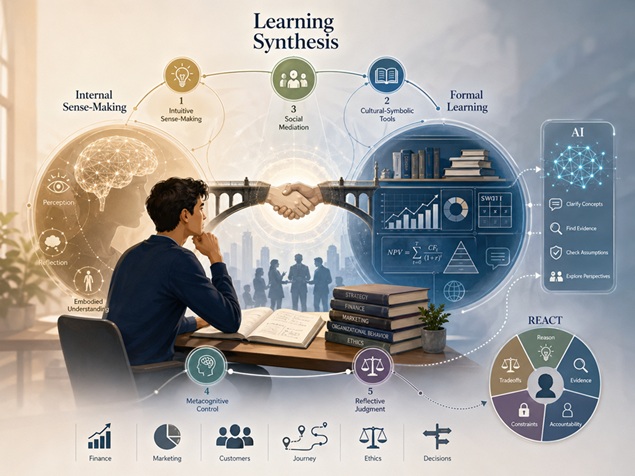
Learning Synthesis, AI, and the Hidden Handshake of Business Education
Internal Sense-Making, Cultural-Symbolic Learning, REACT, and the Development of Professional Judgment Professor Thomas Hormaza DowBusiness Physics AI Lab Abstract This article proposes Learning Synthesis as a practical framework for understanding how business college students develop professional judgment in an AI-rich learning environment. The article argues that learning is not merely the acquisition of external information…
-
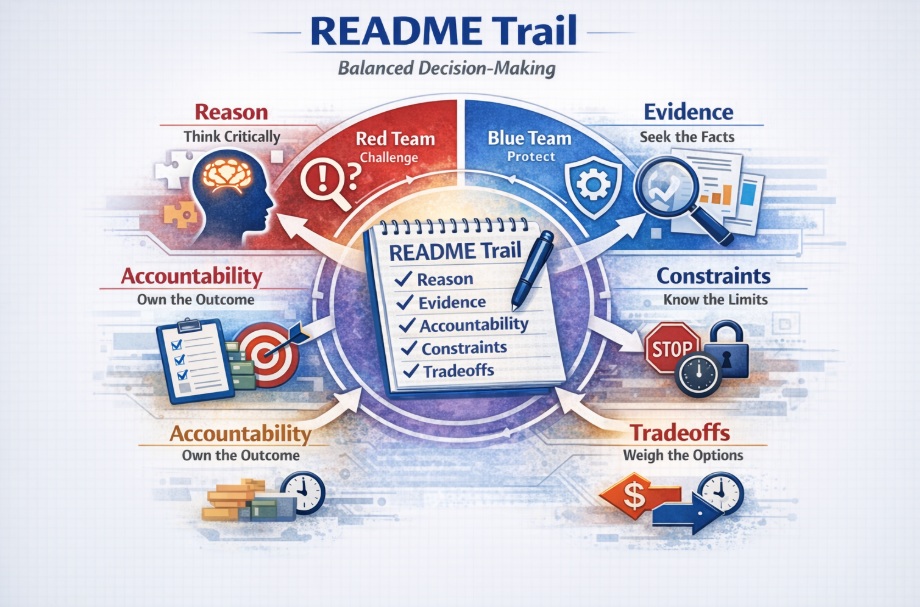
Purple Team Trail: Work with AI
The following is a series of exchanges by members of the Business Physics AI Lab Team: Thomas Hormaza Dow, Vinay Kumar, Hichem Benzair, Aboubakar Samake, Ann Lockquell as well as our AI Agents, Charlie and Lena. How the Business Physics AI Lab preserves judgment in human–AI software development Many teams are now using AI to generate…
-
Staying Current with AI: Habits of a Lifelong Learner
Editor’s Note: This article is based on an interview with Stéphane Paquet, AI Project Lead at Champlain College Saint-Lambert and AI Certificate Coordinator. The responses have been summarized for clarity and brevity and are not word-for-word reproductions of the original conversation. The ideas reflect the speaker’s perspective as of the time of the interview. Question:…
-
The Illusion of Conversation: Rethinking AI Interfaces in Education
Editor’s Note: This article is based on an interview with Stéphane Paquet, AI Project Lead at Champlain College Saint-Lambert and AI Certificate Coordinator. The responses have been summarized for clarity and brevity and are not word-for-word reproductions of the original conversation. The ideas reflect the speaker’s perspective as of the time of the interview. Question:…
-
Writing for AI: The New Literacy We All Need
Editor’s Note: This article is based on an interview with Stéphane Paquet, AI Project Lead at Champlain College Saint-Lambert and AI Certificate Coordinator. The responses have been summarized for clarity and brevity and are not word-for-word reproductions of the original conversation. The ideas reflect the speaker’s perspective as of the time of the interview. Question:…
-
Rethinking Education in the Age of AI: What and How We Teach
Editor’s Note: This article is based on an interview with Stéphane Paquet, AI Project Lead at Champlain College Saint-Lambert and AI Certificate Coordinator. The responses have been summarized for clarity and brevity and are not word-for-word reproductions of the original conversation. The ideas reflect the speaker’s perspective as of the time of the interview. Question:…
-
Understanding AI Hallucinations
AI hallucinations are a modern artificial intelligence problem that makes AI models generate incorrect, fabricated, or nonsensical information. Let’s find out why this happens and why they matter. What are AI Hallucinations? AI hallucinations happen when AI systems produce content that has no basis in their training data or doesn’t align with reality. These errors aren’t random…
-
Understanding Context Window in AI
The context window in AI refers to the maximum amount of text or data an AI model can process in a single interaction. It defines how much information AI can “remember” at once to generate meaningful responses. Analogy: Imagine having a short-term memory limit while reading a book.If you can only remember the last 2…
-
Context Windows & Tokens in AI: A Simple Explanation
Context windows and tokens are two foundational concepts in AI, especially in Large Language Models (LLMs). Understanding these concepts will make more sense of why AI models seem to “forget” parts of the conversation once developed enough as well as why complex prompts can be misinterpreted by the model. What are Tokens ? In AI,…
 English
  Arabic
  Chinese
  French
  Hindi
Hindi  Portuguese
  Spanish