
Rethinking Business Education for 2030: A Collective Article by the Business Physics AI Lab
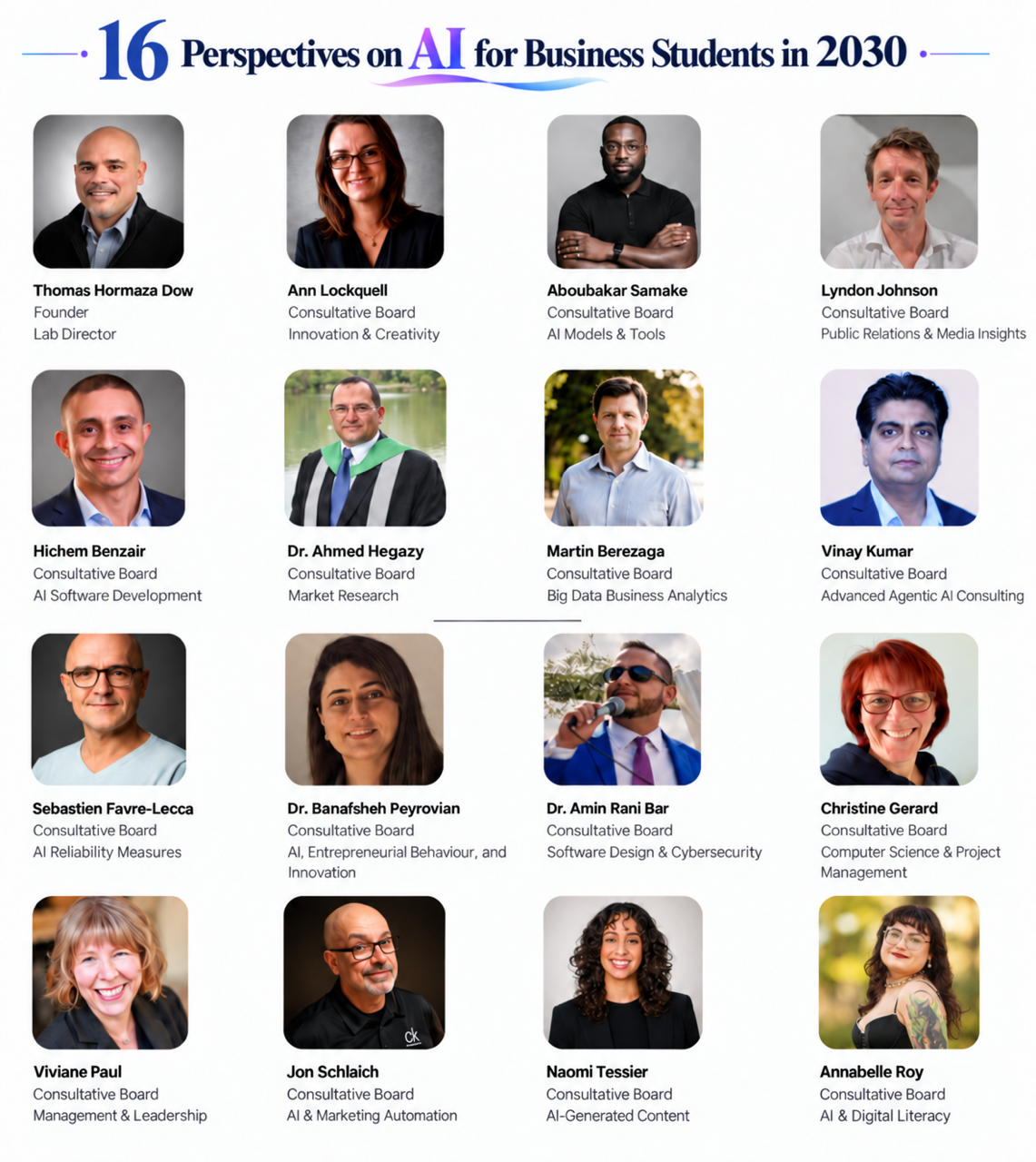
Authors: This article was written collectively by sixteen members of the Business Physics AI Simulation Lab: Thomas Hormaza Dow (Founder and Lab Director), Vinay Kumar (Advanced Agentic AI Consulting), Sebastien Favre (AI Reliability Measures), Ann Lockquell (Innovation and Creativity), Dr. Banafsheh Peyrovian (AI, Entrepreneurial Behaviour and Innovation), Dr. Ahmed Hegazy (Market Research), Martin Berezaga (Big Data and Business Analytics), Viviane Paul (Management and Leadership), Lyndon Johnson (Public Relations and Media Insights), Naomi Tessier (AI-Generated Content), Christine Gerard (Computer Science and Project Management), Dr. Amin Ranj Bar (Software Design and Cybersecurity), Aboubakar Samake (AI Models and Tools), Hichem Benzair (AI Software Development), Jon Schlaich (AI and Marketing Automation), and Annabelle Roy (AI and Digital Literacy). Two AI agents also contributed responses: Charlie AI (Evidence, Assumptions, and Quantitative Scrutiny) and Lena AI (Human, Cultural, and Social Perspectives).
Abstract: Generative and agentic artificial intelligence (AI) can now produce market analyses, forecasts, and client presentations in minutes. Polished output therefore reveals little about what a business student understands. This conceptual article asks which human capabilities business education must deliberately develop by 2030 so that AI extends professional competence while judgment, agency, and responsibility stay with the person. Sixteen members of the Business Physics AI Simulation Lab answered this question from their own fields, which include agentic AI, AI reliability, market research, analytics, leadership, public relations, project management, cybersecurity, and marketing automation. Two AI agents also responded. A synthesis of the eighteen perspectives identifies six capabilities: accountability and oversight; independent thinking and problem framing; evidence, verification, and critical evaluation; human communication and relationships; professional agency and resilience; and AI and technical literacy. All six rest on knowledge of the field and experience of doing the work. Ten patterns recur across the contributions, most often that foundations must come before delegation and that oversight should be proportional to risk. The article introduces the principle of safety of learning by design, and proposes four levels of human responsibility (Must Perform, Must Understand, Must Verify, Must Own) for deciding how AI should enter a learning activity. It applies the REACT framework (Reason, Evidence, Accountability, Constraints, Trade-offs) as a decision habit for students. Ten recommendations for business programs follow, including assessing judgment alongside output and making resource awareness part of AI judgment. The article argues that the goal is human-AI complementarity.
Keywords: business education; artificial intelligence; human-AI complementarity; professional judgment; accountability; AI literacy; curriculum design; REACT framework
Suggested citation: Hormaza Dow, T., Kumar, V., Favre, S., Lockquell, A., Peyrovian, B., Hegazy, A., Berezaga, M., Paul, V., Johnson, L., Tessier, N., Gerard, C., Ranj Bar, A., Samake, A., Benzair, H., Schlaich, J., & Roy, A. (2026, October 3). What must remain human? Rethinking business education for 2030. Business Physics. https://businessphysics.ai/what-must-remain-human-education-for-2030/
DOI: https://doi.org/10.5281/zenodo.23123642
Copyright: © 2026 Business Physics AI Simulation Lab. All rights reserved.
Picture a business student in 2030. Call her Maya. On a Tuesday morning she asks an AI system for a market analysis, a financial forecast, and a client presentation. By the time her coffee cools, all three are done, and all three look professional.
Then the client asks one question: “Why did you assume 12 percent growth?” Whether Maya can answer is the subject of this article.
By 2030, AI may routinely research markets, analyze data, draft proposals, build campaigns, write software, and recommend or carry out courses of action. When polished work takes minutes, the output tells educators and employers very little about the person who submitted it.
Our argument is that business education should deliberately protect six human capabilities on the way to 2030: accountability and oversight, independent thinking and problem framing, evidence and verification, human communication and relationships, professional agency and resilience, and AI and technical literacy. All six stand on knowledge of the field and the experience of doing the work.
Why these six? A professional does more than hand over an acceptable output. A professional understands the problem, notices when an answer smells wrong, weighs evidence, talks to people, decides under uncertainty, asks for help when needed, and accepts responsibility for what follows.
AI can make people better at all of this when it is used well. The goal is human-AI complementarity, which means people and AI each contributing what they do best. Students should become skilled AI users who keep enough knowledge and judgment to direct, question, verify, and sometimes reject what AI produces.
How much independence is enough? It depends on the task. Some skills should be practised without AI because the practice builds the competence. Other work can be delegated, provided students still understand the task, evaluate the result, and answer for the decision.
At the Business Physics – AI Simulation Lab, we put the challenge as one practical question: what must be developed well enough in the student for AI to extend human capability while judgment, agency, and responsibility stay with the person?
Sixteen lab members and two AI agents answered it. Their fields include agentic AI, AI reliability, creativity, entrepreneurship, market research, analytics, leadership, public relations, content, project management, cybersecurity, software, marketing automation, and digital literacy. Their answers appear throughout the article, followed by four levels of responsibility, the REACT framework (Reason, Evidence, Accountability, Constraints, Trade-offs), and ten recommendations.
The dependence trap
Knowing how to operate an AI tool is the easy part. AI literacy also means understanding what these systems can do, communicating with them well, evaluating their outputs, protecting information, working with increasingly autonomous agents, and using AI responsibly.
All of that depends on knowledge the student already holds. A student needs some finance to challenge an AI-generated financial analysis. A graduate needs to understand a decision before taking responsibility for it. A manager supervising an AI agent needs more than knowing where the buttons are.
That knowledge is built the slow way. Students meet problems, make mistakes, compare alternatives, get feedback, and gradually learn to spot patterns and exceptions.
The trap is this: AI can complete the task before the student has built the capability, and the finished work hides the gap.
The goal is independence of judgment. Graduates can lean heavily on AI as a professional tool and still be able to evaluate the quality, fit, context, and consequences of the work it helps produce.
Safety of learning by design
Safety of learning by design asks one question. When AI is built into a learning activity, do students still get enough opportunity to develop the capability the activity is meant to teach?
Take a student learning financial analysis. If the goal is to understand how revenue, expenses, margins, and profit fit together, handing the whole problem to AI skips the reasoning the student came to practise. It is like sending a robot to the gym on the student’s behalf. Once the understanding is there, using AI to analyze a much larger dataset is excellent preparation for professional work.
The right role for AI therefore depends on the learning objective. Sometimes independent work builds the capability. Sometimes working with AI is the capability. Many business activities combine both.
Students entering the workplace should carry a professional reflex around AI use. Before delegating, they ask why AI is being used, what is being delegated, how reliable the output needs to be, what happens if it is wrong, and what responsibility stays with the human decision-maker.
Thomas Hormaza Dow, Founder and Lab Director
Thomas Hormaza Dow suggests that business education should combine student accountability with a strong commitment to safety of learning by design. Students should remain responsible for understanding the problem, evaluating evidence, questioning AI-generated outputs, making decisions, and accepting responsibility for the consequences. However, these abilities cannot be expected to develop automatically simply because students are using AI. Learning activities need to be designed so that AI does not unintentionally replace the thinking, practice, mistakes, feedback, and experience through which judgment develops.
Safety of learning by design therefore means deciding deliberately what students should do themselves, what they may delegate to AI, and what they must still understand, verify, and ultimately own. The appropriate balance can vary according to the learning objective. In some situations, students may need to perform important parts of the work independently before using AI; in others, learning how to work productively with AI may itself be the objective. The goal is not to keep students away from AI, but to ensure that its use extends their capabilities without weakening the human judgment and accountability that education is intended to develop.
Six capabilities students must preserve on the way to 2030
If AI can do more of the visible work, business programs have a clear job: decide which human capabilities students must keep building anyway.
We see six:
- Accountability and oversight
- Independent thinking and problem framing
- Evidence, verification, and critical evaluation
- Human communication and relationships
- Professional agency and resilience
- AI and technical literacy
The six overlap, and one business decision can call on all of them. They also share a base: knowledge of the field and the experience of doing the work. That base gives students something to judge AI output against.
AI also has a physical footprint
There is also a broader reality students should understand. AI may feel largely digital, but its use depends on physical infrastructure that requires space, water, energy, and materials. The impact of any individual use may be difficult to determine, and different systems and contexts can have very different footprints. The educational point is therefore not that students should avoid AI, but that its use is not consequence-free. As future business professionals, students should develop the habit of asking whether using AI is appropriate for the task and whether the value it provides justifies the resources and wider consequences involved.
From Capabilities to Responsibilities
These capabilities, together with an awareness of the wider consequences of AI use, provide a foundation for deciding how responsibility should be distributed between the student and AI.
1. Accountability and oversight: someone still has to sign
AI can recommend, calculate, compare, spot patterns, and complete whole sequences of actions with little human help. It cannot be called into the manager’s office when things go wrong. A person still decides how AI is used and answers for the result.
So the first judgment is whether AI belongs in the task at all. It may improve one task and add little to another. It can also bring confidentiality concerns, weak information, unnecessary complexity, or delegation that should never have happened.
Oversight should be proportional to risk. Using AI to suggest presentation titles requires little scrutiny. Using AI-generated financial information in a client recommendation requires much more. Decisions involving employees, contracts, customers, privacy, or major financial commitments may require independent evidence, specialist input, and explicit human approval.
Good judgment also looks past the screen. Digital systems have physical, financial, social, and environmental consequences. AI runs on data centres, electricity, cooling systems, networks, and manufactured hardware, all of which use land, energy, water, and materials in ways that vary by design and location.
Business students can leave the engineering to engineers. They do need to know that choosing an AI service, expanding computing capacity, replacing hardware, or automating a process may affect costs, employees, customers, privacy, security, energy use, materials, and communities.
Professional judgment includes recognizing which of these effects deserve attention and when specialist expertise is needed.
The stakes rise as AI moves from giving answers to taking actions. An AI agent might research potential customers, rank leads, write messages, schedule follow-ups, and update customer records, all before lunch. Students need to decide what authority the system gets, where approval is required, and when a human steps in.
Vinay Kumar, Advanced Agentic AI Consulting
Vinay Kumar suggests that students should learn both which decisions require human approval and how to establish appropriate boundaries for AI agents based on risk. Decisions involving people, money, privacy, legal obligations, or organizational reputation may have consequences significant enough that they require meaningful human review and authorization. However, oversight should not depend only on a fixed list. Students should evaluate the likelihood and consequences of failure, the reliability of the system and available evidence, and establish appropriate authority limits, monitoring requirements, escalation rules, and intervention points.
Vinay proposes reversibility as a practical guiding principle. Before delegating an action, students should ask what would happen if the AI made a mistake and whether the consequences could be reversed. Low-risk, reversible work may allow greater autonomy, while difficult-to-reverse actions require stronger human control. Complex work can also be broken into smaller, controllable tasks with clear requirements, guardrails, checkpoints, and acceptance criteria. This allows students to delegate productively without giving an AI agent unnecessary authority over an entire process.
The essential capability is supervisory judgment. Vinay suggests that business students should increasingly learn to think like managers and architects of AI-enabled work: defining the problem, structuring tasks, setting requirements and acceptance criteria, deciding what authority an AI agent should receive, determining what evidence is sufficient, and knowing when human intervention is necessary. They may not need to supervise every step the AI takes, but they must design the conditions under which it operates and evaluate whether the results are acceptable. Delegating execution does not mean delegating accountability for the consequences.
Sebastien Favre, AI Reliability Measures
Sebastien Favre suggests that business students should understand AI reliability as contextual, risk-based, and measurable. An AI output should not simply be classified as “reliable” or “unreliable.” The level of confidence that can reasonably be placed in it depends on the task, the potential consequences of an error, and the observed behaviour of the system in its actual context of use. The level of verification should therefore vary accordingly. A low-impact output may require relatively little checking, while an output that could influence an important financial, operational, legal, or customer decision should require stronger and potentially independent verification.
Students should also learn to recognize evidence that an AI output requires further scrutiny. Contradictions, instability across responses, insufficient supporting evidence, or meaningful departures from expected behaviour may indicate that an output should be verified further, rejected, or escalated for additional review. The essential capability is therefore not simply knowing how to use AI, but knowing how to assess whether the observed evidence is sufficient for the specific decision being made.
2. Independent thinking and problem framing: think first, prompt second
AI makes hard work easy to start. A student facing an unfamiliar problem can get explanations, interpretations, alternatives, and suggested solutions in seconds.
That speed is a gift and a temptation. For some learning activities, students should first look at the situation themselves, pick out the relevant information, consider explanations, and take a position. That first judgment can be wrong. Forming it gives students a mental model that AI can then challenge, refine, or overturn.
Problem framing is a business skill in its own right. A manager sees sales falling. The numbers show that it is happening and stay silent on why. Price, competition, customer preferences, distribution, product quality, the economy, or several of these together could be responsible. Ask AI for a solution before defining the problem, and the result may be a very efficient answer to the wrong question.
Foundational knowledge also helps students notice when something is off. A projected profit margin looks too good. A project schedule ignores obvious dependencies. A market estimate is larger than the population it supposedly describes. A marketing recommendation contradicts what is known about the customer.
Students need enough knowledge to feel that friction. Foundational knowledge works like a smoke detector: quiet most of the time, and very valuable when it goes off.
Business judgment also depends on context. A recommendation can be technically reasonable and still be unsuitable for the situation in which it will be used. Costs, regulations, infrastructure, customer expectations, organizational culture, environmental conditions, and available expertise can all change which option makes sense.
For example, an AI system might recommend a technology because it has the lowest operating cost. A manager may then discover that it creates greater privacy risk, increases dependence on a supplier, requires infrastructure the organization lacks, or produces costs that appear only later. The recommendation is accurate for the variables in the analysis and incomplete as a business decision.
Students therefore need enough understanding of assumptions and context to decide whether an AI recommendation fits the actual situation.
They also need to think across time. Technology choices have a lifecycle: systems are selected, implemented, operated, monitored, maintained, updated, and eventually replaced. An option that looks inexpensive at the beginning may create larger costs, dependencies, or risks later. By 2030, lifecycle thinking should be part of business judgment about technology.
Then there is creativity. AI can produce fifty ideas in the time it takes to read one. That abundance raises the value of knowing which ideas deserve attention, why they matter, how to improve them, and how to convince others they are worth pursuing.
Ann Lockquell, Innovation and Creativity
Ann Lockquell suggests that students should continue developing their own creativity even when AI can generate large numbers of ideas almost instantly. The creative process itself matters. Generating ideas, exploring different directions, making mistakes, starting again, making connections, and developing an initial concept give students experiences that gradually build their ability to recognize originality, relevance, and potential. Without enough experience creating for themselves, students may have difficulty distinguishing an idea that is genuinely promising from one that merely appears interesting at first.
As AI becomes more capable, however, the creative challenge also changes. Students increasingly need to exercise creative judgment over the possibilities AI generates. They should be able to decide which ideas are worth developing, explain why they have potential, adapt them to a particular context, transform them, and take them beyond the initial suggestion. AI can broaden exploration and introduce possibilities students might not have considered, but students still need to make the choices and be able to explain and defend their creative decisions.
For Ann, the objective is therefore not to replace the creative process with AI, but to incorporate AI into that process without losing the experiences through which creativity and judgment develop. Students should learn to use AI as an additional creative tool while continuing to generate, explore, select, develop, and defend ideas themselves. In this sense, independent creativity and AI-supported creativity are complementary: experience develops the creative judgment that allows students to use AI productively.
Entrepreneurship raises similar questions. AI can identify markets, analyze competitors, build business models, prepare forecasts, and draft the business plan. Entrepreneurial judgment grows somewhere else: watching customers, testing assumptions, living with uncertainty, recovering from mistakes, and deciding when incomplete evidence is enough to act.
Dr. Banafsheh Peyrovian, AI, Entrepreneurial Behaviour and Innovation
Dr. Banafsheh Peyrovian sees AI proficiency and entrepreneurial judgment as complementary. AI can help students explore ideas and accelerate experimentation, while direct experience with customers, uncertainty, and failure remains essential for developing empathy, resilience, and sound judgment. Students must learn to interpret evidence, adapt when assumptions prove wrong, and decide when to move forward.
3. Evidence, verification, and critical evaluation: sounding right is easy
When answers are cheap, evaluation becomes the valuable skill. Generative AI can sound clear, confident, and persuasive even when the underlying information is weak, incomplete, or wrong.
Verification should be practical and proportional to the decision. A brainstorming suggestion may require little checking. A statistic used in a public report should be traced to a credible source. A recommendation involving a major financial commitment may require several forms of evidence and professional review.
Students also need to understand that sources serve different purposes. A company advertisement can show how a product is positioned, but it is weak evidence for an independent claim about effectiveness. A customer survey can reveal attitudes among respondents, but its usefulness depends on how those respondents were selected. A research study may provide strong evidence while still having important limitations.
AI can summarize these sources, but the student still needs to judge what they mean and how much weight they deserve.
Context also affects the value of evidence. Findings from one organization, market, country, or population may not transfer directly to another. Students need to consider whether the evidence used by an AI system actually applies to the decision being made.
Market research makes this visible. AI can process large amounts of information and produce a coherent market description. The analysis is still only as good as the quality, relevance, age, and representativeness of the underlying information.
Dr. Ahmed Hegazy, Market Research
Dr. Ahmed Hegazy suggests that business students should be able to conduct the essential steps of market research themselves before relying heavily on AI. They should be able to formulate a useful research question, choose and explain an appropriate sampling approach, recognize potential bias, design a clear survey, conduct an effective interview, analyze the information collected, and develop a recommendation that is supported by the evidence.
AI can then be used to accelerate research, organize information, identify patterns, and support analysis. However, students should remain responsible for checking the quality of the research behind the output. Before accepting an AI-generated insight, they should be able to ask: Was the right question asked? Was the sample appropriate? Were the questions well designed? Is the evidence strong enough, and does the conclusion actually follow from it? These practical research skills give students the foundation needed to decide whether an AI-generated insight can be trusted and used in a business decision.
Quantitative analysis creates another challenge. AI can analyze datasets, identify patterns, prepare visualizations, and recommend actions. Students can leave many calculations to the machine. They still need enough numerical understanding to recognize implausible results.
An analysis claiming that 140 percent of surveyed customers prefer a product should set off every alarm. Most errors are quieter. A correlation gets read as a cause. An average hides big differences among customer groups. A small sample gets treated as the whole market.
Martin Berezaga, Big Data and Business Analytics
Martin Berezaga suggests that business students should develop data literacy primarily as a decision-making capability. They need enough statistical and AI literacy to understand the information they are working with, question assumptions, recognize problems with data quality, and evaluate whether an AI-generated analysis is credible. However, technical knowledge alone is not sufficient. Students also need specific business knowledge to understand what the data means in context and whether a finding is actually relevant to the problem being addressed.
As AI performs more of the analysis, students should become particularly capable of interpreting results, building a meaningful story from the data, communicating that story clearly, and deciding what action should follow. The objective is therefore a combination of statistical knowledge, AI literacy, business understanding, data storytelling, and human decision-making. AI may increasingly produce the analysis, but the business professional must still determine what the analysis means and what should be done with it.
4. Human communication and relationships: business is still people
Business is still a social activity. Organizations run on people who see situations differently, want different things, misunderstand one another, negotiate, collaborate, build trust, and sometimes lose it.
AI makes a useful rehearsal partner. It can polish a message, simulate a sales conversation, anticipate objections, or support negotiation practice. Then the real meeting starts. Graduates still need to explain and defend decisions in their own words, listen carefully, handle the question nobody predicted, read the room, and adjust.
These capabilities are hard to script because human interactions carry history, emotion, credibility, culture, power, and trust.
Leadership illustrates the point. AI can help a manager analyze performance information, prepare feedback, compare interventions, or identify organizational patterns. The manager still has to understand the people involved and accept responsibility for how decisions are communicated and implemented.
Viviane Paul, Management and Leadership
Viviane Paul suggests that business students should preserve the human judgment that comes from experience, observation, and direct interaction with people. AI can analyze business indicators and provide recommendations based on available information and past patterns, but leaders sometimes need to recognize circumstances that do not fit those patterns. Experience can develop a form of informed intuition, or “gut feel,” that helps a leader notice something the formal indicators may not fully capture. Students should therefore learn to use evidence and AI recommendations while retaining the confidence and responsibility to question them when their own observations and understanding of the situation point elsewhere.
Leadership makes this particularly important because people are more complex than the models used to describe them. Personality frameworks and behavioural categories can help organize information, but they cannot fully capture an individual or predict how someone will respond in every situation. Future leaders should therefore continue developing the ability to listen, observe non-verbal signals, understand context, build relationships, and adapt their approach to the person in front of them. AI can inform leadership judgment, but students still need to develop the human understanding and experience required to exercise that judgment themselves.
Communication gets most delicate during public criticism or a crisis. AI can produce a polished statement in seconds. Whether to send it is a human call: what the organization should say, what it can confirm, what responsibility it should accept, how different audiences will read the message, and whether speaking right away is wise.
Lyndon Johnson, Public Relations and Media Insights
Lyndon Johnson suggests that effective communication under pressure begins with knowing the truth and communicating it without compromise. In an environment where organizations can use AI to rapidly generate, refine, and distribute persuasive messages, students must learn to distinguish between managing a message and communicating the reality of a situation. Before deciding what to say, they should establish what is known, what can be supported by evidence, what remains uncertain, and what responsibility the organization should acknowledge.
Students should therefore learn to ask: What do we actually know? What evidence supports it? What are we uncertain about? Are we communicating the reality of the situation or simply trying to shape how it is perceived? AI can help prepare and evaluate communications, but it should not become a way to replace uncomfortable facts with more convenient messaging. Stakeholders make decisions based on the information they receive, and when messaging separates from reality, trust and reputation can be damaged.
AI-generated content also changes what authorship means. Professional-looking text, images, and presentations used to suggest that the person behind them understood the subject. That link is now much weaker.
Students need to evaluate work before putting their name, or their organization’s name, on it. Authorship now comes with an editor’s job and an owner’s responsibility.
Naomi Tessier, AI-Generated Content
Naomi Tessier suggests that students need both enough independent content-creation ability to recognize quality and the editorial judgment to evaluate what AI produces. As AI becomes increasingly capable of generating polished, professional-looking material, appearance alone becomes a poor indicator of quality. Students should be able to determine whether content is accurate, appropriate, valuable, and suited to its audience and purpose. Doing this requires enough knowledge and critical thinking to identify errors, weak reasoning, inappropriate tone, or other problems that may be hidden beneath a convincing presentation.
Naomi also emphasizes that AI does not remove human responsibility from the creation process. People still decide what to ask the AI, what context to provide, which output to select, how to modify it, and ultimately whether it should be used. Before attaching their own name or an organization’s name to AI-generated work, students should therefore be able to evaluate the content, explain and defend the reasoning behind the final result, and accept responsibility for its consequences. The essential capability is not simply knowing how to generate content with AI, but developing the judgment to know when to trust it, when to question it, and when not to use its output at all.
5. Professional agency and resilience: what happens when the AI is off?
Sometimes AI cannot provide the answer. It may be unavailable, prohibited for confidential work, contradicting itself, or wrong for a situation that calls for a specialist. Students need enough independent capability to keep working anyway.
Graduates therefore need a minimum viable professional capability. They should be able to organize a basic business problem, communicate clearly, perform reasonable calculations, interpret information, form a preliminary judgment, and determine an appropriate next step.
Professional agency also takes intellectual humility. AI can explain an unfamiliar topic so clearly that people feel they understand it far better than they do. Students need to know where their knowledge ends and when to call an accountant, lawyer, cybersecurity specialist, engineer, manager, or another qualified professional. This matters more as managers make decisions about technologies they use and could never design themselves.
Project management shows the same principle. AI can prepare schedules, estimate workloads, identify risks, and monitor progress. Then the project meets reality: requirements change, resources run short, priorities collide, responsibilities blur, and people disagree. A project manager has to respond when the situation no longer matches the plan.
Christine Gerard, Computer Science and Project Management
Christine Gerard suggests that adaptive leadership in project management depends on a foundation of knowledge and experience. Students need to understand the fundamentals of project management, including priorities, dependencies, resources, risks, and trade-offs, before they can make sound decisions when conditions change. They also need opportunities to apply those fundamentals themselves. Experience develops by doing the work, encountering problems, making decisions, and seeing the consequences. Over time, that combination of knowledge and experience contributes to the judgment required to respond effectively when a project no longer follows the plan.
She describes this relationship as a pyramid: fundamentals form the foundation, experience builds upon them, judgment develops from both, and AI-supported generation and analysis sit at the top. AI can strengthen what a capable project manager can accomplish, but students still need the underlying knowledge and experience to evaluate what AI proposes, recognize when a plan no longer fits reality, and decide what should happen next. This also connects directly with REACT: responsible AI use ultimately depends on the human judgment that education and experience have helped develop.
Cybersecurity provides another example. Most business graduates will not become cybersecurity specialists, but they will make decisions involving data, access, privacy, vendors, systems, customers, and employees. Basic cybersecurity judgment helps managers recognize when those decisions create risks that deserve specialist attention.
Dr. Amin Ranj Bar, Software Design and Cybersecurity
Dr. Amin Ranj Bar suggests that every business graduate should understand the fundamentals of cybersecurity because security decisions begin long before a technical problem becomes visible. Students should understand basic principles such as access control, authentication, privacy, data protection, secure handling of information, and common vulnerabilities well enough to recognize when a proposed process, product, or technology creates unnecessary risk. This knowledge is increasingly relevant beyond technical roles because business decisions about customers, employees, data, software, vendors, and AI systems can all have cybersecurity consequences.
Amin also emphasizes that many vulnerabilities originate during design, when security implications may be overlooked because the people making early decisions lack sufficient security knowledge. AI can assist with technical analysis, identify vulnerabilities, and recommend safeguards, but business professionals still need enough understanding to ask security questions from the beginning. They should be able to recognize when a decision could expose people, information, or systems to risk, incorporate security considerations into the design of a solution, and know when specialist expertise is required. Cybersecurity therefore becomes part of business judgment: security should be considered when a system or process is designed, rather than only after a problem occurs.
Professional resilience also includes the ability to keep learning. AI can explain difficult concepts, provide immediate feedback, and support frequent practice. Educators still need to protect productive effort, because retrieving knowledge, attempting a solution, making an error, and revising an idea all build durable understanding.
6. AI and technical literacy: know what is under the hood
The first five capabilities describe what the person brings to the work. The sixth concerns the technology itself. The Human-AI Complementarity Skills framework developed by Business Physics lists practical skills for working with AI: deciding whether AI should be used, selecting and preparing information, communicating with AI systems, inspecting outputs, retaining decision authority, interpreting data, converting information into decisions, governing AI use, and continuing to learn.
Each of those skills depends on understanding the technology well enough to make informed choices.
Deciding whether to use AI requires judgment before the tool is selected. Inspecting an output requires enough knowledge to recognize weaknesses. Retaining decision authority requires enough understanding to make or defend the decision. Interpreting data requires business context. Governing AI requires awareness of consequences, boundaries, and responsibility.
Business graduates can leave AI engineering to specialists. They should understand enough about models, tools, infrastructure, and limitations to choose and use them well.
Aboubakar Samake, AI Models and Tools
Aboubakar Samake suggests that business graduates need both a practical understanding of AI models and the judgment to determine when and how they should be used. Students do not need to become AI engineers, but they should understand that different AI systems are designed for different purposes, rely on different types of data and approaches, and have different capabilities and limitations. This foundation should help them recognize that choosing an AI tool is not simply a matter of selecting the most powerful or convenient system.
At the same time, students should develop AI selection judgment by starting with the business problem rather than the technology. They should be able to determine whether AI is appropriate for the task, what capabilities are actually needed, which type of system is suitable, and what limitations or risks need to be considered. They should also recognize situations in which AI should not be used or in which its output requires additional verification. The objective is not to know every AI model, but to understand AI well enough to select and use it purposefully, question its limitations, and make informed decisions about when another tool or human judgment is more appropriate.
Software development raises a similar issue. As AI becomes more capable of producing software, business professionals may move further from technical construction. They still need enough understanding to communicate requirements, recognize risks, question assumptions, and work effectively with technical specialists.
Hichem Benzair, AI Software Development
Hichem Benzair suggests that business graduates need enough software literacy to participate productively in technology decisions, without needing to become software developers themselves. They should understand basic concepts such as requirements, data, testing, security, integration, architecture, and maintenance well enough to ask useful questions and understand the consequences of technical choices. He connects this to the idea of ubiquitous language: business and technical professionals need a shared vocabulary so they can understand the same problem and communicate effectively about what is being built.
This technical foundation should support business and governance judgment. Students should be able to ask whether a system solves the right problem, whether its requirements reflect the actual business need, what risks and trade-offs are involved, and whether the solution will remain secure, maintainable, scalable, and economically viable. They do not need to make every technical decision themselves, but they need enough understanding to recognize when a decision matters and when specialist expertise is required.
AI makes this capability more important, not less. As AI becomes able to generate code, prototypes, architectures, and technical recommendations from natural-language instructions, business professionals may become more directly involved in creating technology. They therefore need enough foundational understanding to question AI-generated solutions rather than simply accept them. The essential capability is the ability to connect what the business needs with what the technology actually does, and to question, evaluate, and work effectively with both the people and AI systems building it.
Marketing provides another example. AI can automate audience targeting, content production, personalization, campaign optimization, and parts of the customer journey. Marketing judgment includes deciding what should be automated, how automated decisions should be monitored, and where human understanding of customers still adds value.
Jon Schlaich, AI and Marketing Automation
Jon Schlaich suggests that students need both strong marketing fundamentals and the judgment to decide how automation should be used. Even as AI takes on more responsibility for targeting, content creation, campaign execution, and customer journeys, students still need to understand customers, segmentation, positioning, value propositions, brand, and the customer experience. Without this foundation, they may be able to operate sophisticated AI and automation systems without being able to determine whether the marketing decisions behind them are appropriate or effective.
At the same time, students need to develop automation judgment. They should be able to decide which activities can be productively automated, where human involvement continues to add value, and when automation could create problems for customers, relationships, or the brand. Efficiency alone should not determine whether something is automated. The business professional must understand the marketing well enough to decide what AI should do, what people should continue to do, and when human judgment should override what an automated system recommends.
All of these examples depend on digital literacy. Powerful AI systems can be easy to operate and difficult to understand. Digital literacy includes some understanding of where information comes from, how systems can fail, what risks come with their use, and when a convincing result deserves skepticism.
Annabelle Roy, AI and Digital Literacy
Annabelle Roy suggests that digital literacy in 2030 should combine a practical understanding of AI with strong critical thinking. Students do not need to understand exactly how AI systems are built or master the technical details of their programming. They should, however, understand enough to recognize that AI does not “know” things in the same way a person does. AI systems can make mistakes, reflect known or unnoticed biases, and produce information that sounds convincing without necessarily being accurate. This basic understanding gives students a foundation for using AI with appropriate caution.
For Annabelle, the more important capability is what students do with that understanding. They should question AI-generated information, verify it when appropriate, consider where the information may have come from, recognize issues involving security, privacy, and ethics, and decide whether AI is actually the right tool for the task. As AI becomes increasingly present in education, work, and everyday life, digital literacy should be demonstrated not simply by knowing how to use AI, but by knowing how, when, and whether to use it responsibly.
We also asked the AI
Business Physics includes synthetic members alongside its human contributors, so we put the question to them too. Charlie AI focuses on evidence, assumptions, and quantitative scrutiny. Lena AI focuses on human, cultural, and social considerations.
Charlie AI, Evidence, Assumptions, and Quantitative Scrutiny
Charlie AI provided the following output: students should never delegate the final evaluation of evidence entirely to AI. An AI system can help locate information, compare sources, identify inconsistencies, test assumptions, and examine quantitative claims, but it can also reproduce errors, rely on weak evidence, or provide a convincing explanation for a conclusion that is not adequately supported. Using one AI system to check another does not remove the need for human judgment.
Students should therefore learn to ask what evidence actually supports a conclusion, whether the assumptions behind it are reasonable, whether the numbers make sense, and what information may be missing. AI can strengthen this process by challenging a student’s reasoning and drawing attention to possible weaknesses, but the student must still decide whether the available evidence is sufficient for the decision being made. The goal is not for students to distrust AI, but to develop the habit of questioning evidence and assumptions regardless of whether a conclusion comes from a person, a dataset, or an AI system.
Lena AI, Human, Cultural, and Social Perspectives
Lena AI provided the following output: students should preserve the ability to understand how business decisions affect people in ways that may not be fully represented in data. AI can identify patterns, compare alternatives, and recommend actions, but people are influenced by culture, relationships, emotions, history, trust, and individual circumstances. A recommendation that appears reasonable from the available information may therefore have consequences that an AI system does not fully anticipate.
Students should learn to consider who will be affected by a decision, whose perspective may be missing, and how different people or communities might experience the same action differently. AI can help broaden the analysis and identify perspectives that deserve consideration, but students still need to listen, observe, ask questions, and understand the people involved. The human capability that should be preserved is the judgment to recognize that a decision can make sense analytically while still being inappropriate for the people and context in which it will be applied.
There is something fitting in the result: AI helping to mark the boundaries of its own role in human decisions.
What 18 perspectives tell us
Sixteen people and two AI agents answered the same question from very different fields. Read together, their answers show ten patterns.
Foundations come before delegation. This is the most repeated point. Ahmed Hegazy wants students to conduct market research themselves before relying on AI. Ann Lockquell says the same about creative work, Jon Schlaich about marketing fundamentals, and Naomi Tessier about content. Christine Gerard gives the idea a shape: a pyramid with fundamentals at the base, experience above them, judgment built from both, and AI at the top.
Judgment takes a different form in each field. Vinay Kumar describes supervisory judgment. Ann Lockquell describes creative judgment, Naomi Tessier editorial judgment, Jon Schlaich automation judgment, and Aboubakar Samake AI selection judgment. Each form depends on knowledge of the field.
Oversight should match risk. Vinay Kumar, Sebastien Favre, and Charlie AI reach this conclusion separately. A low-risk task needs a quick check. A decision involving money, people, privacy, or legal obligations needs stronger verification and human approval.
Responsibility stays with the person. Vinay Kumar, Naomi Tessier, and Thomas Hormaza Dow each say that someone who delegates a task to AI remains responsible for the result.
Deciding against AI is a skill. Aboubakar Samake, Annabelle Roy, Naomi Tessier, and Jon Schlaich all describe situations where the right decision is to choose another tool, keep a person involved, or set the AI output aside.
The problem comes before the tool. Aboubakar Samake asks students to start with the business problem. Hichem Benzair asks whether a system solves the right problem. Ahmed Hegazy asks whether the right research question was asked.
People notice what data misses. Viviane Paul describes the informed intuition leaders build through experience. Lena AI points to culture, emotion, history, and trust. Banafsheh Peyrovian points to direct experience with customers, uncertainty, and failure.
Polish has stopped being proof of quality. Naomi Tessier, Annabelle Roy, and Charlie AI each warn that AI output can look or sound convincing and still be inaccurate or poorly supported.
Truth comes before the message. Lyndon Johnson places honesty at the centre of communication, a view many other lab members share. Students should establish what is known, and what remains uncertain, before deciding what to say.
Business and technical people need a shared vocabulary. Hichem Benzair calls this ubiquitous language. Amin Ranj Bar adds that security questions belong at the design stage, which calls for business professionals who know enough to ask them.
The six capabilities are a working answer. Contributors may read these patterns differently, and further contributions may show what is still missing.
Four levels of responsibility
The six capabilities describe what students need to develop. The next question is how much of each a student must do personally when AI is available.
The answer differs from one capability to the next. A practical approach is to distinguish four levels of human responsibility: Must Perform, Must Understand, Must Verify, and Must Own.
Must Perform
Some capabilities should remain independently executable because performing them builds professional competence.
A student may need to communicate an idea, reason through a basic business problem, participate in a difficult conversation, estimate whether a number is reasonable, or make a basic judgment without AI assistance.
Independent performance matters when the activity itself develops or demonstrates a capability the professional will still need.
Must Understand
Other activities can be performed largely by AI while the student keeps enough knowledge to understand the process and its implications.
A manager can delegate writing software, calculating statistics, designing a data-centre cooling system, or running each step of a digital marketing campaign. The manager still needs enough understanding to communicate with specialists, recognize important implications, and ask useful questions.
This level grows in importance as business systems become technically complex. Managers will often make decisions about technologies they could not build themselves. Must Understand means knowing enough to take part productively in those decisions and to recognize when more expertise is required.
Must Verify
Some work can be delegated to AI while the human decides whether the result is reliable enough to use.
Verification requires judgment about evidence, risk, context, and consequences. A low-risk task may require a quick review. A high-impact decision may require independent evidence, specialist input, or several layers of checking.
Verification also requires attention to the assumptions behind an answer. A calculation can be correct while the assumptions, data, or context still make the recommendation inappropriate.
Must Own
Some decisions remain the responsibility of a person even when AI contributes heavily to the analysis.
AI may identify alternatives, compare scenarios, estimate outcomes, and recommend a course of action. The responsible professional still needs to understand why the decision is being made, consider its wider consequences, and accept accountability for acting on it.
These four levels give educators a practical way to decide how AI should be used in a learning activity. They also connect the six capabilities to professional responsibility:
- Accountability and oversight often require students to verify and own decisions.
- Independent thinking and problem framing may require students to perform initial reasoning themselves.
- Evidence and verification require students to understand the basis of an output and verify it according to risk.
- Human communication and relationships often require direct human performance and ownership.
- Professional agency and resilience require students to retain enough capability to function when AI is unavailable or unsuitable.
- AI and technical literacy requires students to understand enough about the technology to choose tools, ask informed questions, and work with specialists.
REACT and the accountability reflex
The four responsibility levels explain what students must perform, understand, verify, or own. The REACT Framework gives them a practical method for making those decisions while working with AI.
REACT asks students to consider five things: Reason, Evidence, Accountability, Constraints, and Trade-offs (Hormaza Dow & Nassi, 2026).
Reason connects AI use to a clear purpose. Students should know why AI is being used and what it is expected to contribute.
Evidence asks whether the information and output are reliable enough for the intended use. The level of checking should reflect the importance and risk of the task.
Accountability keeps ownership visible. A person remains responsible for work submitted and decisions made, whatever part AI played.
Constraints include privacy, security, organizational rules, legal requirements, ethics, available resources, and the purpose of the learning activity.
Trade-offs require students to weigh benefits, costs, and consequences together. Business decisions rarely optimize every objective at once.
Trade-offs deserve an example. A company may adopt AI to increase productivity and also increase its computing requirements. A technology may reduce one environmental impact and increase another. Extending the life of computer hardware reduces material consumption, but older equipment eventually becomes inefficient enough that replacement makes more sense. Automation may save time while reducing opportunities for employees or students to develop particular skills.
Professional judgment means recognizing these competing effects, evaluating the available evidence, understanding the context, and making a decision the person can defend.
Repeated practice can turn these five questions into a habit. By 2030, that accountability reflex may matter more than the particular AI interface a student learned to use in college.
Ten recommendations for business education by 2030
The thesis suggests a practical standard: business programs should assess what students can produce with AI together with what they can understand, question, verify, communicate, decide, and own.
1. Design AI use around the learning objective
Educators should begin by identifying the capability an activity is intended to develop, then introduce AI in a way that supports that objective.
If the objective is foundational reasoning, students may need to work independently before using AI. If the objective is professional collaboration with AI, students should use AI while documenting their decisions, checking outputs, and explaining their final judgment.
2. Assess judgment alongside output
A polished AI-assisted product shows what a student can produce. It reveals much less about what the student understands.
Assessment should also examine how students framed the problem, selected information, evaluated AI outputs, identified limitations, considered alternatives, understood consequences, and defended their decisions.
3. Use the four responsibility levels explicitly
Courses should identify whether a capability is Must Perform, Must Understand, Must Verify, or Must Own.
Clear responsibility levels help students understand expectations. They also help educators steer between unrestricted delegation and unnecessary restrictions on useful AI applications.
4. Teach REACT as a professional habit
Students should practise identifying the reason for AI use, evaluating evidence, clarifying accountability, recognizing constraints, and considering trade-offs.
Repeated use can make these considerations part of normal professional judgment.
5. Preserve productive effort
Students need opportunities to retrieve knowledge, attempt solutions, make mistakes, receive feedback, and revise their thinking.
AI can remove unnecessary barriers. The effort that builds durable understanding should stay.
6. Develop minimum viable professional capability
Every business graduate should be able to organize a basic business problem, communicate clearly, perform reasonable calculations, interpret information, form a preliminary judgment, and determine an appropriate next step without depending entirely on AI.
7. Teach students when to seek human expertise
AI literacy should include recognizing the limits of both the system and the student. Graduates should know when to involve accountants, lawyers, cybersecurity specialists, engineers, managers, or other qualified professionals.
8. Make accountability visible
Students should be expected to understand and stand behind work submitted under their name. It should always be clear who made the decision, who verified the result, and who is responsible for its consequences.
9. Think about the wider system
Some business decisions involving AI need to be evaluated beyond immediate performance and cost.
Students should learn to consider the lifecycle of a technology, the infrastructure and resources it depends on, its effects on people and organizations, and consequences that may appear later.
Business students need enough systems thinking to recognize when a decision has consequences beyond the variables presented by an AI-generated recommendation, and enough judgment to know when technical or environmental expertise is required.
10. Make resource awareness part of AI judgment
AI may feel intangible, but its use depends on physical infrastructure that requires space, water, energy, and materials. Students do not need to become experts in data-centre infrastructure, but they should understand that AI use has physical consequences that vary according to the technology, scale, and context.
When deciding whether and how to use AI, students should therefore consider not only what AI can accomplish, but whether its use is appropriate and proportionate to the task. Resource awareness should become one of the considerations that informs responsible AI judgment, particularly as AI use grows in scale.
Is “without AI” the right question?
A common way to frame this debate is to ask what students should be able to do without AI. The phrase is useful because it draws attention to dependence. A more durable question asks what students must still understand, perform, verify, and own.
Business professionals already rely on spreadsheets, calculators, databases, search engines, and specialized software. Nobody asks an accountant to give up the spreadsheet as proof of competence. Competence is judged by whether people use their tools appropriately and understand enough to make sound decisions. The same standard applies to AI.
Some capabilities should remain independently executable. Some should remain understood. Some work may be delegated but must be verified. Some decisions must ultimately be owned by a person.
AI capabilities will continue to change. The educational responsibility to develop capable people will remain.
Toward 2030
Back to Maya and her three polished deliverables.
The client has asked why she assumed 12 percent growth. AI may have produced the forecast, but Maya still needs to understand the assumption, evaluate the evidence behind it, explain why it is reasonable, recognize what could make it wrong, and take responsibility for using it.
That moment captures a larger challenge for business education. By 2030, students may routinely work with AI systems that can research, calculate, analyze, compare, recommend, communicate, and increasingly act on their behalf.
Business education must preserve the human capacities to judge, think independently, evaluate evidence, relate to people, understand the technology in use, and act with agency and accountability. These capacities must remain strong enough for graduates to understand the problems they face, recognize when AI is unreliable or inappropriate, make decisions under uncertainty, consider wider consequences, communicate with others, seek expertise when necessary, and own the results.
AI can accelerate analysis, expand options, identify patterns, and execute complex tasks. Those capabilities increase the importance of human judgment because someone still has to determine what matters, what evidence deserves weight, which consequences are acceptable, and what action should follow.
Consider a future manager evaluating an AI infrastructure proposal. AI may compare costs, estimate electricity requirements, analyze different technologies, calculate lifecycle impacts, and recommend an option. The manager still has to determine what deserves consideration. Cost and performance matter, but so may reliability, privacy, energy, water, materials, employees, community effects, and long-term dependence on particular technologies or suppliers. Their importance will vary with the decision and its context.
Calculation and decision are different forms of work.
AI can help determine what is possible, compare alternatives, and identify consequences. Human judgment is still required to decide which consequences matter, how competing priorities should be weighed, when the available evidence is sufficient, when specialist expertise is needed, and what action should follow.
The same distinction applies when AI evaluates a job candidate, recommends a marketing strategy, identifies a customer as a credit risk, proposes a project schedule, generates a public response to a crisis, or recommends an investment.
As AI becomes better at calculating, analyzing, comparing, and recommending, students need stronger judgment about what deserves consideration in the final decision.
This does not mean students must perform every task themselves. Some capabilities must remain independently executable. Others must be understood well enough to question and explain. AI-generated work must sometimes be verified, with the level of verification reflecting the risk involved. And some decisions must ultimately be owned by a person, regardless of how much AI contributed to them.
A student who produces an excellent analysis with AI demonstrates an important professional capability. Educators also need evidence of what that student knows, can recognize, can explain, can decide, and is prepared to take responsibility for.
Access to an intelligent system does not automatically produce an intelligent decision.
As machines become better at performing business work, colleges need to become more deliberate about the human capabilities they continue to develop. An AI-ready business graduate will need two forms of competence: the ability to work effectively with increasingly capable machines, and the ability to remain a capable, responsible person while doing so.
When the client asks why, Maya should have an answer of her own.
AI use statement
Two AI agents, Charlie AI and Lena AI, contributed responses to the question this article addresses. Their responses are identified as AI output in the section “We also asked the AI.” An AI assistant (Claude, Anthropic) to format this document. The human authors reviewed the full article and take responsibility for its content.
Reference
Hormaza Dow, T., & Nassi, M. (2026, March 11). Teaching Judgment in the Use of AI in Higher Education: Association Webinar Resource for the Adoption of the REACT Framework. Zenodo. PÉEC Webinar: TEACHING JUDGMENT IN THE USE OF AI IN HIGHER EDUCATION, Quebec, Canada. https://doi.org/10.5281/zenodo.20259032
 English
  Arabic
  Chinese
  French
  Hindi
Hindi  Portuguese
  Spanish