
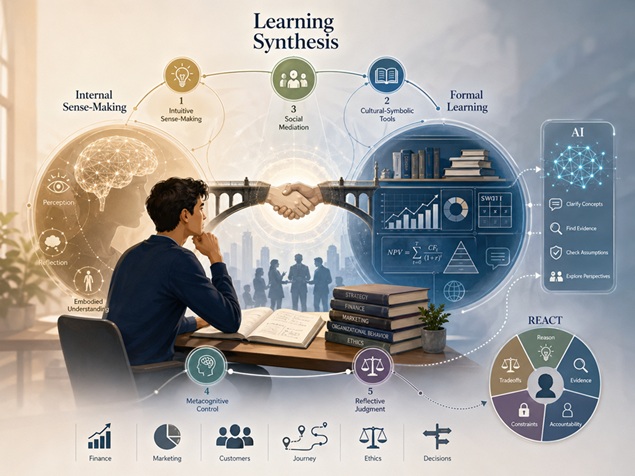
Internal Sense-Making, Cultural-Symbolic Learning, REACT, and the Development of Professional Judgment
Professor Thomas Hormaza Dow
Business Physics AI Lab
Abstract
This article proposes Learning Synthesis as a practical framework for understanding how business college students develop professional judgment in an AI-rich learning environment. The article argues that learning is not merely the acquisition of external information or the production of polished artifacts. Instead, human learning depends on a recursive relationship among intuitive sense-making, cultural-symbolic tools, social mediation, metacognitive monitoring, and reflective judgment. Neurological learning differences such as dyscalculia, dyslexia, dysgraphia, developmental language disorder, and developmental coordination disorder help make visible what is often hidden in typical learning: the need to connect perception, symbol, language, action, and meaning. For business education, this insight matters because students must learn to connect intuitive forms of sense-making–fairness, proportion, trust, risk, story, pattern, friction, identity, and consequence–to formal business concepts and evidence-based professional judgment. The article integrates the REACT framework: Reason, Evidence, Accountability, Constraints, and Tradeoffs as a way of making judgment visible. It concludes that artificial intelligence can support learning when it scaffolds reflection, verification, practice, and transfer, but may create the appearance of learning when it produces polished outputs without requiring students to notice, test, explain, and own their reasoning.
Keywords: Learning Synthesis; business education; artificial intelligence; REACT; metacognition; reflective judgment; sense-making; sociocultural learning; professional judgment
| Authorial note: Learning Synthesis is proposed here as a synthesis developed by Professor Thomas Hormaza Dow at the Business Physics AI Lab. It is not presented as a pre-existing named theory. It draws from established research traditions including grounded cognition, sociocultural learning, conceptual change, self-regulated learning, cognitive load theory, reflective judgment, and human-centred AI in education. |
1. Introduction: The Problem of Learning That Looks Like Learning
Generative artificial intelligence has made it easier than ever for students to produce work that looks complete, polished, structured, and professional. A student can now generate a business plan, summarize a reading, create a marketing strategy, draft a sales script, prepare a slide deck, or write a reflection in a fraction of the time such tasks once required. This creates an educational problem that is deeper than plagiarism or academic integrity alone.
The deeper problem is that a polished output does not prove that learning has taken place. A student may submit a strong-looking analysis without having developed the internal judgment that the assignment was designed to cultivate. AI can produce the language of understanding before the student has developed the structure of understanding. It can help students complete tasks without necessarily helping them internalize the concepts, assumptions, evidence, constraints, and tradeoffs behind those tasks.
This article argues that higher education, especially business education, should evaluate AI-assisted learning not only by the quality of student outputs, but by whether AI strengthens or bypasses the relationship between internal sense-making and formal learning. The central claim is that learning becomes real when formal knowledge connects to internal sense-making, and teaching becomes powerful when it helps students build, reveal, test, and strengthen that connection.
2. The Hidden Handshake of Learning
Learning is not only the acquisition of information. It is the integration of external cultural systems with internal human capacities. By cultural learning, I mean the formal systems that education introduces: words, symbols, concepts, categories, frameworks, formulas, methods, rubrics, procedures, and professional vocabularies. By internal sense-making, I mean the learner’s ability to notice, compare, estimate, feel, recognize, question, trust, doubt, interpret, and judge before or alongside formal instruction.
The relationship between these two dimensions can be described as a hidden handshake. Formal symbols and concepts become meaningful when they connect to internal structures of perception, experience, and sense-making. In mathematics, for example, students do not begin with formulas. They often begin with a more basic sense of quantity: more or less, bigger or smaller, close or far, many or few. Number symbols become meaningful when they connect to this internal sense of magnitude and quantity.
Research on approximate number sense supports this general direction. Feigenson, Libertus, and Halberda (2013) reviewed evidence linking the Approximate Number System with later formal mathematics. Dehaene and Cohen’s (2007) neuronal recycling hypothesis also suggests that cultural inventions such as reading and arithmetic recruit older neural systems rather than appearing on a blank slate. These lines of work support a broader educational insight: formal learning often builds by connecting cultural-symbolic systems to pre-existing cognitive, perceptual, or embodied capacities.
3. What Learning Differences Reveal
Neurological learning differences are often discussed as deficits, accommodations, or barriers. They are indeed real sources of difficulty for students. However, they also reveal something profound about ordinary learning: they expose bridges that education often assumes are already functioning. Used carefully, these examples help educators see that learning difficulties may involve a weakened connection between internal processing and external symbolic, linguistic, motor, or cultural systems.
This article does not use these conditions as diagnostic categories for business students. Rather, it uses them as educational lenses. Dyscalculia, dyslexia, dysgraphia, developmental language disorder, and developmental coordination disorder each point to a different kind of bridge: quantity to number, sound to print, thought to writing, inner meaning to language, and intention to action. They remind us that a student can appear to struggle with a school task while the deeper issue may be a fragile connection between sense and symbol, sound and print, thought and language, or intention and execution.
| Condition | Internal side | Cultural / symbolic / practical side | What it reveals about learning |
| Dyscalculia | Quantity, magnitude, proportion | Numbers, operations, formulas | Mathematics depends on connecting number symbols to internal magnitude sense. |
| Dyslexia | Spoken language, sound, meaning | Letters, spelling, print, written words | Reading depends on connecting written symbols to sound and meaning. |
| Dysgraphia | Thought, intention, language | Written expression, spelling, handwriting, organization | Writing depends on connecting ideas to written form and production. |
| Developmental language disorder | Thought, perception, intention, social meaning | Vocabulary, grammar, oral explanation | Learning often depends on connecting inner meaning to usable language structures. |
| Developmental coordination disorder / dyspraxia | Intention, body awareness, planned action | Movement, sequencing, handwriting, tool use | A learner may know what he wants to do but struggle to execute the action pathway. |
These examples support a cautious but important educational conclusion: learning is not merely output. Learning depends on internal connections that allow symbols, language, writing, actions, and concepts to become meaningful and usable. The examples should be used selectively and respectfully; they do not prove that all learning works the same way, but they make visible the hidden architecture that teaching often has to support.
4. From Learning Differences to Business Education
Business education may appear far removed from dyscalculia, dyslexia, dysgraphia, developmental language disorder, or developmental coordination disorder. But the lesson transfers powerfully. Business students are also learning to connect internal sense-making with cultural-professional systems. They learn terms such as segmentation, positioning, customer value, margin, cash flow, brand identity, stakeholder, ethics, governance, accountability, strategy, feasibility, risk, operations, service design, and tradeoff.
Knowing the words is not the same as understanding the concepts. A student does not understand customer value because he can repeat a definition. He understands customer value when he can recognize whether a product, service, message, or experience matters from the customer’s perspective. A student does not understand financial feasibility because he can complete a spreadsheet. He understands feasibility when he can sense whether the numbers are plausible, question assumptions, identify hidden costs, and explain why a business idea may survive or fail.
Business education is therefore not only about content acquisition. It is about judgment development. The educator’s work is to help students transform early reactions into disciplined professional judgment.
5. Intuitive Sense-Making in Business Students
Business students often arrive with intuitive capacities that are not yet professionalized but are educationally valuable. These capacities are not expertise. They are not always reliable. They may be biased, culturally shaped, incomplete, emotional, or naive. But they are often the starting point for disciplined learning.
A student may sense that a price increase feels unfair, that profit numbers seem unrealistic, that a marketing message sounds generic, that a sales tactic feels manipulative, that a customer journey is frustrating, or that an AI answer sounds too confident. These first impressions matter because they show the student’s first contact with meaning. The educator does not simply validate these impressions. The educator helps the student test them, name them, refine them, and connect them to evidence and professional concepts.
| Intuitive sense | Business concept | Judgment developed |
| Fairness sense | Ethics, pricing, trust | Ethical judgment |
| Proportion sense | Finance, margins, feasibility | Financial judgment |
| Story sense | Marketing, positioning, value proposition | Relevance judgment |
| Social sense | Sales, service, leadership | Relational judgment |
| Pattern sense | Segmentation, analytics | Analytical judgment |
| Risk sense | Entrepreneurship, strategy | Strategic judgment |
| Friction sense | Operations, customer journey | Process judgment |
| Trust sense | AI governance, evidence, accountability | Epistemic judgment |
| Identity sense | Branding | Positioning judgment |
| Consequence sense | Management | Managerial judgment |
The movement is not from intuition to certainty. It is from intuition to inquiry. The student learns to move from “something feels wrong” to “I can explain what is wrong,” from “this seems risky” to “I can analyze the risk,” and from “I do not trust this AI answer” to “I can identify what evidence, verification, and accountability would be required.”
6. Learning Synthesis: A Five-Layer Model
The two-part distinction between intuitive sense-making and cultural learning is useful, but it is not sufficient. Learning is not simply intuition plus instruction. A fuller model should include social mediation, metacognitive monitoring, and reflective judgment. I propose the term Learning Synthesis to describe this recursive process.
Learning Synthesis is the process through which learners connect intuitive sense-making, cultural-symbolic tools, social mediation, metacognitive control, and reflective judgment in order to transform experience and information into disciplined professional judgment. It is a synthesis because no single layer is enough. Intuition notices, concepts name, evidence tests, dialogue mediates, reflection monitors, judgment decides, and experience recalibrates intuition.
| Learning layer | REACT connection | Supporting learning theory, researchers, and APA citation anchors |
| Intuitive sense-making | Reason: Why does this feel like the right problem or decision? | Grounded cognition and embodied cognition: cognition is grounded in perception, action, introspection, and situated experience (Barsalou, 2008). Conceptual change and knowledge-in-pieces: learners begin with intuitive fragments that can be reorganized into formal understanding (diSessa, 1993). |
| Cultural-symbolic tools | Evidence: What concepts, data, and sources support this? | Sociocultural theory and symbolic mediation: language, signs, tools, and formal concepts mediate higher mental development (Vygotsky, 1978, 1986). Neuronal recycling suggests cultural inventions recruit older neural systems (Dehaene & Cohen, 2007). |
| Social mediation | Constraints: What rules, context, ethics, and stakeholder limits shape this? | Zone of proximal development, situated learning, and communities of practice: learning is shaped by guidance, participation, context, and professional norms (Lave & Wenger, 1991; Vygotsky, 1978). |
| Metacognitive control | Tradeoffs: What am I gaining, losing, simplifying, or risking? | Self-regulated learning and cognitive load theory: learners monitor, evaluate, adapt strategies, and manage limited cognitive resources (Sweller, 1988; Zimmerman, 2002). |
| Reflective judgment | Accountability: What do I own in the final decision? | Reflective judgment, experiential learning, and transformative learning: learners’ reason through ill-structured problems, reflect on experience, and revise assumptions (King & Kitchener, 1994; Kolb, 1984; Mezirow, 1991). |
Learning Synthesis is therefore not a claim that biology determines learning. It is a claim that teaching should help students connect prior sense-making, formal concepts, social context, self-monitoring, and accountable decision-making. It also recognizes that formal learning can change intuition. A finance course can sharpen proportion sense. A marketing course can sharpen relevance sense. An ethics course can refine fairness sense. An AI governance course can sharpen trust and evidence sense.
7. REACT as a Judgment-Making Structure
REACT–Reason, Evidence, Accountability, Constraints, and Tradeoffs–fits naturally inside Learning Synthesis because it gives students a visible structure for judgment. REACT helps prevent two common errors. The first is intuition without discipline: “I feel this is right, so it must be right.” The second is AI output without judgment: “AI said this, so it must be right.”
REACT creates a middle path. The student has an intuition, but must test it. The student may use AI, but must verify it. The student may produce a recommendation, but must own it. In this sense, REACT is not merely an AI-use framework. It is a judgment-development framework.
8. From Intuition to Professional Judgment: The Business Education Pathway
The challenge for business educators is not to treat intuition as truth, but to treat it as the beginning of inquiry. Students often arrive with reactions that are educationally useful but professionally incomplete. They may feel that a price is unfair, that a business idea is risky, that a marketing message is vague, that a customer interaction feels manipulative, or that an AI-generated answer should not be trusted. These reactions matter because they reveal the student’s first contact with meaning.
However, intuition alone is not judgment. Intuition can be biased, culturally shaped, emotionally reactive, or incomplete. The role of business education is to help students discipline intuition through concepts, evidence, constraints, and accountability. A useful pathway is: Notice, Name, Test, Decide, Own.
First, students notice something through intuitive sense-making. Second, they name it using business language. Third, they test it with evidence, alternatives, constraints, and stakeholder perspectives. Fourth, they decide by making a recommendation or rejecting an option. Finally, they own the decision by explaining their reasoning, accepting accountability, identifying tradeoffs, and describing what they would monitor or revise. This pathway shows students that professional judgment is neither pure instinct nor mechanical rule-following. It is a disciplined movement from first perception to responsible action.
9. AI as Scaffold or Substitute
AI can play two very different roles in learning. It can be a scaffold, or it can become a substitute. As a scaffold, AI helps students access, practice, compare, revise, test, and reflect. It can generate alternative examples, ask students questions, simulate customers, provide feedback, and make practice more available. Used carefully, AI can support students who face barriers in reading, writing, organization, or language access.
As a substitute, AI performs the cognitive work that the student was supposed to develop. It supplies the reasoning, structure, language, evidence, analysis, and even reflection, while the student becomes an editor or submitter rather than a learner. The same tool can do either. The difference is pedagogical design.
The OECD’s Digital Education Outlook 2026 states that generative AI can support learning when guided by clear teaching principles, but warns that outsourcing tasks to generative AI without pedagogical support may enhance student performance without producing real learning gains (OECD, 2026). UNESCO’s guidance similarly emphasizes a human-centred approach to generative AI in education and research (UNESCO, 2023). These concerns align with the Learning Synthesis argument: AI should be judged not only by what it helps students produce, but by what it helps students develop.
10. Implications for Assessment
If AI changes production, assessment must pay more attention to judgment. This does not mean abandoning outputs. Business students still need to produce reports, plans, presentations, analyses, and recommendations. Professional work requires deliverables. But educators should increasingly assess the reasoning trail behind those deliverables.
A useful assessment design includes four layers: output, explanation, verification, and transfer. Output shows what the student produced. Explanation shows whether the student can explain the work. Verification shows whether the student checked evidence and assumptions. Transfer shows whether the student can apply the concept in a new situation. Transfer is especially important because it is one of the strongest signs that the hidden handshake is forming.
For example, if a student understands segmentation, he should be able to apply it not only to a clothing brand, but also to a bank, a nonprofit, a SaaS product, or a local restaurant. If he understands AI governance, he should be able to apply it to marketing automation, HR screening, customer service chatbots, and financial advising.
11. Practical Teaching Moves for Business Educators
Educators can design learning experiences that make internal sense-making visible. Before students submit a final answer, they can be asked to explain what they first noticed, what confused them, what AI suggested, what they accepted, what they rejected, and what evidence changed their mind.
In marketing, students can compare a generic AI-generated value proposition with a customer-grounded version and explain which one is stronger and why. In finance, students can identify the least plausible assumption in a cash-flow forecast. In sales, they can compare manipulative and consultative scripts. In operations, they can map a frustrating customer journey and identify points of friction. In AI governance, they can run a REACT check on an AI-generated recommendation.
These activities preserve the value of AI while preventing AI from hiding the absence of learning. They ask students not merely to use tools, but to reveal judgment.
12. Conclusion: The Human Handshake That Must Still Happen
Neurological learning differences teach us that learning depends on connections that are often invisible until they fail. Dyscalculia reveals the bridge between quantity and number. Dyslexia reveals the bridge between sound and print. Dysgraphia reveals the bridge between thought and written expression. Developmental language disorder reveals the bridge between inner meaning and language. Developmental coordination disorder reveals the bridge between intention and action.
Business education reveals another set of bridges: fairness to ethics, proportion to finance, story to marketing, social sense to leadership, pattern recognition to analytics, risk sense to strategy, friction sense to operations, trust sense to AI governance, identity sense to branding, and consequence sense to management. These bridges matter because business education is not only about producing assignments. It is about developing disciplined professional judgment.
AI can help. It can provide explanations, examples, simulations, feedback, scaffolding, and access. Used well, it can strengthen Learning Synthesis. But AI can also produce the visible signs of learning without proving that internal learning has occurred. It can produce fluency without internalization, completion without development, and polish without judgment.
The central educational question is therefore not whether AI belongs in higher education. The question is whether AI strengthens or bypasses the hidden handshake between internal sense-making and formal learning. For business educators, the goal is human learning made stronger, more visible, and more accountable through thoughtful use of AI.
References
Barsalou, L. W. (2008). Grounded cognition. Annual Review of Psychology, 59, 617-645. https://doi.org/10.1146/annurev.psych.59.103006.093639
Chung, P. J., Patel, D. R., & Nizami, I. (2020). Disorder of written expression and dysgraphia: Definition, diagnosis, and management. Translational Pediatrics, 9(Suppl. 1), S46-S54. https://doi.org/10.21037/tp.2019.11.01
Dehaene, S., & Cohen, L. (2007). Cultural recycling of cortical maps. Neuron, 56(2), 384-398. https://doi.org/10.1016/j.neuron.2007.10.004
diSessa, A. A. (1993). Toward an epistemology of physics. Cognition and Instruction, 10(2-3), 105-225. https://doi.org/10.1080/07370008.1985.9649008
Feigenson, L., Libertus, M. E., & Halberda, J. (2013). Links between the intuitive sense of number and formal mathematics ability. Child Development Perspectives, 7(2), 74-79. https://doi.org/10.1111/cdep.12019
International Dyslexia Association. (n.d.). Definition of dyslexia. https://dyslexiaida.org/definition-of-dyslexia/
King, P. M., & Kitchener, K. S. (1994). Developing reflective judgment: Understanding and promoting intellectual growth and critical thinking in adolescents and adults. Jossey-Bass.
Kolb, D. A. (1984). Experiential learning: Experience as the source of learning and development. Prentice-Hall.
Lave, J., & Wenger, E. (1991). Situated learning: Legitimate peripheral participation. Cambridge University Press.
Mezirow, J. (1991). Transformative dimensions of adult learning. Jossey-Bass.
National Center for Learning Disabilities. (n.d.). Specific learning disabilities. https://ncld.org/understand-the-issues/specific-learning-disabilities/
National Institute on Deafness and Other Communication Disorders. (2023). Developmental language disorder. https://www.nidcd.nih.gov/health/developmental-language-disorder
Hormaza Dow, T., & Nassi, M. (2025, November 27). Framework for teaching judgment in the use of AI. Éductive. https://eductive.ca/en/resource/framework-for-teaching-judgment-in-the-use-of-ai/
Organisation for Economic Co-operation and Development. (2026). OECD Digital Education Outlook 2026. OECD Publishing. https://www.oecd.org/en/publications/oecd-digital-education-outlook-2026_062a7394-en.html
Sweller, J. (1988). Cognitive load during problem solving: Effects on learning. Cognitive Science, 12(2), 257-285. https://doi.org/10.1207/s15516709cog1202_4
UNESCO. (2023). Guidance for generative AI in education and research. https://unesdoc.unesco.org/ark:/48223/pf0000386693
Vygotsky, L. S. (1978). Mind in society: The development of higher psychological processes. Harvard University Press.
Vygotsky, L. S. (1986). Thought and language (A. Kozulin, Trans.). MIT Press.
Zimmerman, B. J. (2002). Becoming a self-regulated learner: An overview. Theory Into Practice, 41(2), 64-70. https://doi.org/10.1207/s15430421tip4102_2
 English
  Arabic
  Chinese
  French
  Hindi
Hindi  Portuguese
  Spanish
Leave a Reply
You must be logged in to post a comment.